

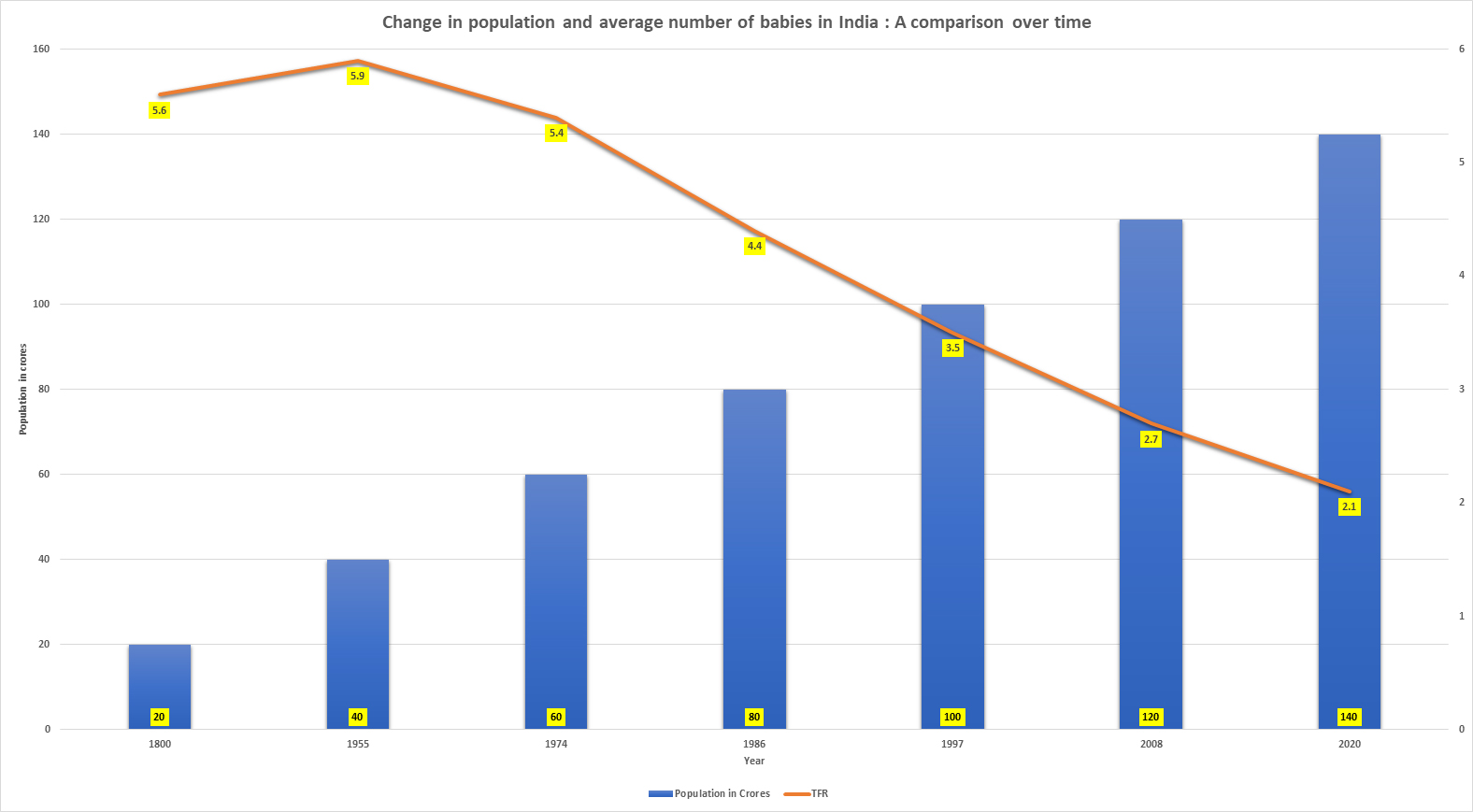
Discussions on India’s population often stir anxieties about overpopulation and calling for stringent population control. Yet, data tells a story of progress and hope. India’s population grew from 200 million in 1800 to 1.4 billion in 2021, with notable milestones: 300 million in 1920, 400 million in 1955, 600 million in 1974, 800 million in 1986, and 1 billion in 1998. As the population grew, India witnessed equitable opportunities and progress in the four pillars of Self, Society, Science, and System.
The advances in science made medicines, vaccines, contraception, and communication technologies within the reach of the masses. Pro-poor governance brought scientific advancements closer to society and drove progress across the spectrum by changing traditional perspectives. The resultant liberal environment encouraged and empowered women to make sound, unbiased decisions to pursue education, delay pregnancy, and join the workforce.
Highlighting the intersection of gender, demography, and development, these demographic shifts showed that lower fertility rates result from reduced poverty, enhanced gender equity, and better access to education and healthcare, especially for women, leading to more informed family planning.
Remarkable Achievement
The total fertility rate (TFR) has dropped from 6 children per woman when India’s population was 500 million to around 2 at 1.4 billion in 2021. This decline aligns with improvements in child survival (from 28% to 3% mortality), women’s education (from 0.4 to 5.6 years), and poverty reduction (from 63% to 10% living in extreme poverty between 1977 and 2020). This is a remarkable achievement for a hugely populated, newly formed democracy that was marred with massive developmental challenges at the time of independence, only 75 years ago.
However, India’s population will stabilize in a few decades because of falling fertility rates among all communities. Because of its history of religious diversity, India will have the world’s largest populations of two of the three largest religions, Islam and Hinduism, with Hinduism’s share remaining unchanged, debunking myths.
Despite this progress, disparities persist. A recent survey shows higher TFRs among disadvantaged groups: illiterate women (2.8) and the poorest (2.6), compared to Muslims (2.4). These groups also face high child mortality (11.8 for illiterate mothers, 11.6 for the poorest, 9 for scheduled tribes, and 8.6 for scheduled castes versus 6.9 overall), linking slower TFR declines to systemic issues like poverty, caste, and patriarchy.
The emerging public health training and higher education curriculum must address these challenges. Curricula should integrate courses on social demography to analyse emerging population trends and landscapes through socioeconomic and cultural lenses, emphasizing how poverty and gender shape outcomes. The courses should include case studies on marginalized communities, while gender-focused training should explore patriarchal barriers to reproductive health. Capacity-building workshops on gender-sensitive policymaking can equip experts to design inclusive interventions to accelerate TFR declines, reduce child mortality, and promote social justice and equity.
The theme of World Population Day 2025 underscores the importance of investing in demographic data to understand population trends and drive sustainable development. India must counter its age-old narrative of population control by investing in disaggregated data to acknowledge disparities across caste, class, and gender.
Policymakers and program planners must use such analyses for informed decision-making to redesign population interventions and promote informed choices and equitable opportunities for individuals. With falling TFRs, India’s population will stabilize, maintaining its diverse socio-religious fabric. The need of the hour is to cover the last mile by focusing on the margin. Rather than fuelling divisive narratives, India must prioritize affirmative actions to assist the most marginalized by bridging systemic gaps and ensuring socioeconomic parity across caste, class, and religion.

Mayur Trivedi is faculty at Azim Premji University
The views and opinions expressed in this article are those of the author and do not necessarily reflect the views or the position of the organization they represent.