
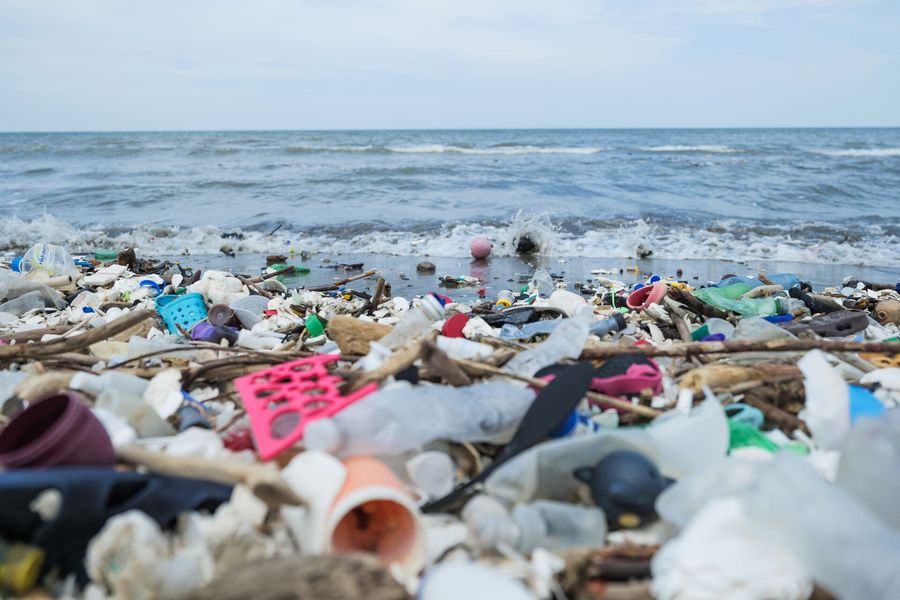
At a time when plastic pollution is choking oceans, filling landfills, and entering our food systems, Apratima’s work represents a rare blend of hope and hard science. The company’s innovation doesn’t just aim to clean up plastic- it seeks to close the loop by transforming waste into valuable resources for a circular economy.
The Problem with Plastic
Polyethylene Terephthalate, or PET, is one of the world’s most commonly used plastics. It’s in everything, from water bottles to food packaging to polyester clothes. But while its convenience is unmatched, its durability is its greatest curse. Once discarded, PET lingers for centuries, fragmenting into microplastics that contaminate soil, water, and even human bloodstreams.
Traditional recycling can only do so much. Most recycled plastics lose quality each time they’re processed and eventually end up in landfills or incinerators. What the world has long needed is a way to break plastic back down into its original building blocks– a process called depolymerization– and reuse them to make new, virgin-quality plastic again.
That’s where Apratima steps in.
Nature-Inspired Science

Dr. Kavyasree and her team at Apratima Biosolutions are developing bioengineered enzymes that can degrade PET plastic rapidly, efficiently, and sustainably. Inspired by natural microorganisms found in the environment, these enzymes are optimized in the lab to target the tough molecular bonds of PET.
Within hours, the enzymes can digest plastic waste into its fundamental monomers, which can then be repolymerized to make new plastic- with no loss of quality.
“Plastic doesn’t have to be the villain,” says Dr. Kavyasree. “If we can return it to its chemical origins safely and reuse it infinitely, it becomes part of a sustainable material cycle rather than a pollutant.”
Incubated at IIM-Bangalore, Powered by Research
Apratima’s journey began at NSRCEL, the startup hub at IIM Bangalore, where it was incubated as part of a program to support science-led entrepreneurs. Backed by competitive R&D grants, the startup now operates from C-CAMP (Centre for Cellular and Molecular Platforms), one of India’s premier biotechnology incubators.
Being part of this ecosystem has given Apratima access to state-of-the-art infrastructure, mentorship from top researchers, and industry networks crucial for scaling deep-tech innovation.
Over the past year, the company has been refining its enzyme formulations, improving efficiency, and testing scalability- with an eye on developing a pilot plant capable of processing plastic waste at a meaningful scale.
Reimagining the Plastic Lifecycle
If successful, Apratima’s enzymatic recycling technology could radically alter how plastic is managed across industries- from beverage manufacturers to packaging companies to fashion brands looking to close their material loops. Instead of downcycling or discarding PET, producers could break it down and rebuild it- endlessly.
This shift could significantly reduce carbon emissions, decrease dependence on fossil fuels, and prevent millions of tons of plastic from entering the environment each year.
But beyond technology, Apratima’s work symbolizes a broader mindset shift. “It’s not just about fixing plastic,” Dr. Kavyasree explains. “It’s about rethinking how we design materials and systems so that waste itself becomes a resource.”
The Future of Plastic May Be Enzymatic
As the global community races to find scalable, climate-positive solutions, Apratima Biosolutions stands out as a story of Indian ingenuity meeting planetary urgency. By harnessing the power of biology to address one of humanity’s biggest environmental challenges, the startup is not only offering a technological solution- it’s also providing a new philosophy of coexistence between innovation and nature.
In Dr. Kavyasree’s words, “If we can teach enzymes to eat plastic, maybe we can teach ourselves to live lighter on the Earth.”