
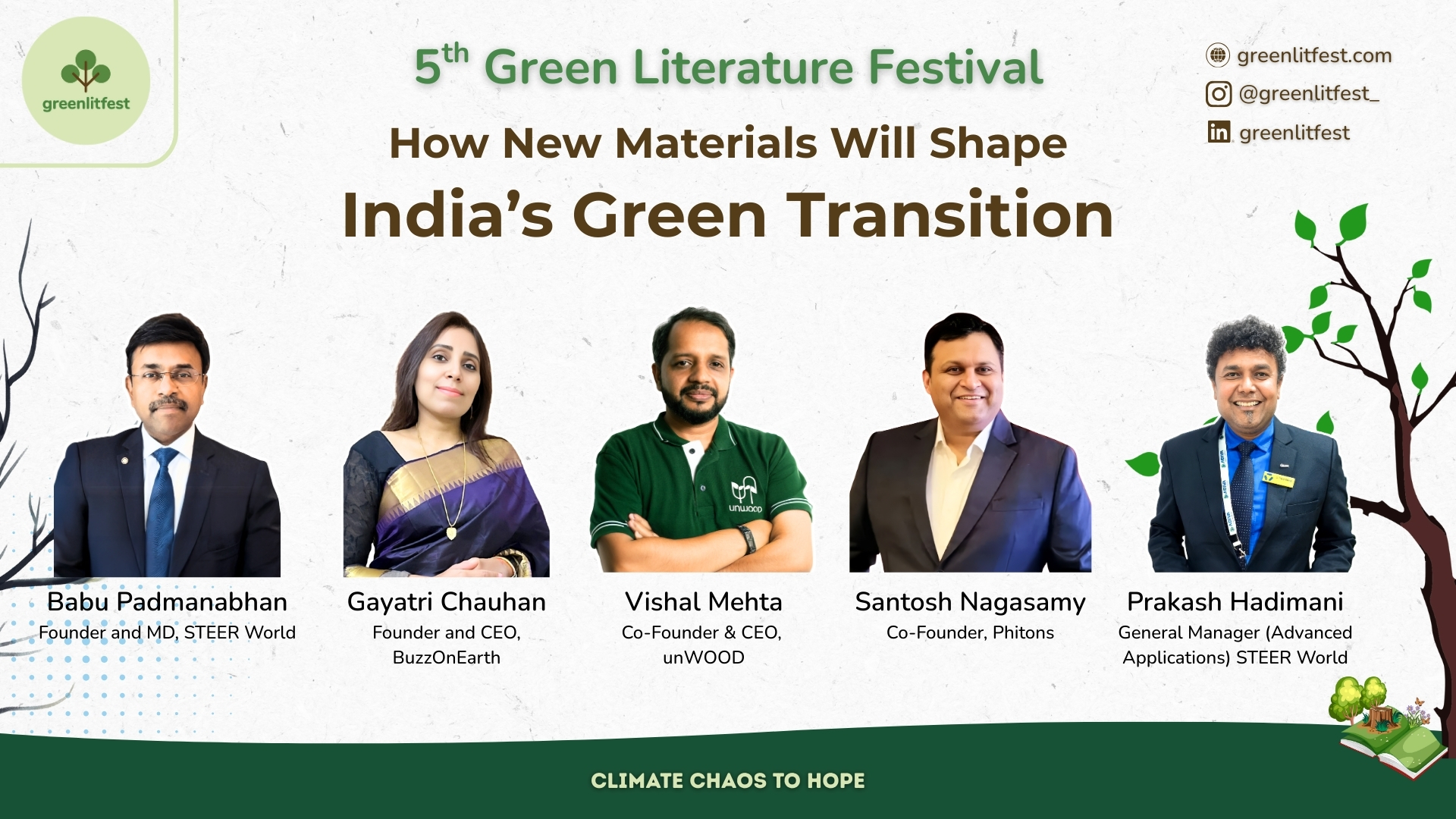
At the 5th edition of the Green Literature Festival in Bangalore late November 2025, the green business segment brought together pioneers and enablers of sustainable innovation to spark dialogue on managing the enormous volume of waste materials.
The panel discussion on ’How New Materials Will Shape India’s Green Transition‘ hosted by Gayatri Chauhan, Founder and CEO of BuzzOnEarth featured industry leaders like Babu Padmanabhan, Founder and MD, STEER World and Prakash Hadimani, General Manager from STEER World – a firm altering material chemistry to explore and create more sustainable options. They were in dialogue alongside innovators like Vishal Mehta, Co-Founder & CEO of unWOOD and Santosh Nagasamy, Co-Founder of Phitons. Together, they tackled fundamental questions about what makes materials truly sustainable and how India can accelerate its green transition.
The conversation began with a sobering reality. When humans create new synthetic materials and molecules, we often release them into the world with limited understanding of how they interact with biological systems and natural processes. This knowledge gap has created consequences that we are only beginning to comprehend now. Studies suggest we now consume the equivalent of a credit card’s worth of microplastics each week, with tire wear and clothing being the largest contributors.
To a question about the difference between ‘green’ and ‘renewable’, Dr. Babu emphasised that the terms aren’t synonymous. True green materials should support thriving biological systems rather than interfering with them while renewables are tapping into a circular source.
It is estimated that by 2050, current practices could render much of our soil unfarmable due to the load of pesticides, and other additives. Plastic is omnipresent beyond our imagination too. Materials like plastic mulch, used widely in agriculture, also degrade soil health at the molecular level through microplastics entering the soil strata due to sun exposure. Countless mom-and-pop shops India’s commercial backbone rely on single-use plastic since it is commercially viable and convenient.
Indian innovators are responding with practical solutions. Phitons is developing plastic alternatives inspired by orange and banana peels, retaining plastic’s useful properties while being sustainable at scale. It has created the world’s first compostable mulch with materials designed to assimilate naturally with the environment.
Companies like unWOOD are moving beyond isolated solutions toward systemic thinking about material lifecycles. As India confronts massive infrastructural needs, end-of-life considerations must be built into material design right from the drawing board stage.
It is a race against the clock. The panel made it clear that India’s green transition depends on fundamentally reimagining how we design, produce, and dispose of materials; thinking at the molecular level and considering biological compatibility is a good place to start. Conversations like these are vital for understanding use-cases of new materials and, simply, the possibility of large-scale change that moves the needle forward.