
India’s energy demand is rising rapidly, driven not only by industrial growth but also by everyday household consumption. While national conversations often focus on renewable capacity and large infrastructure, a significant share of electricity savings lies hidden in homes—in how appliances are used, maintained, and switched off. Behavioural change at the household level remains one of the most cost-effective yet underutilised tools for energy conservation.
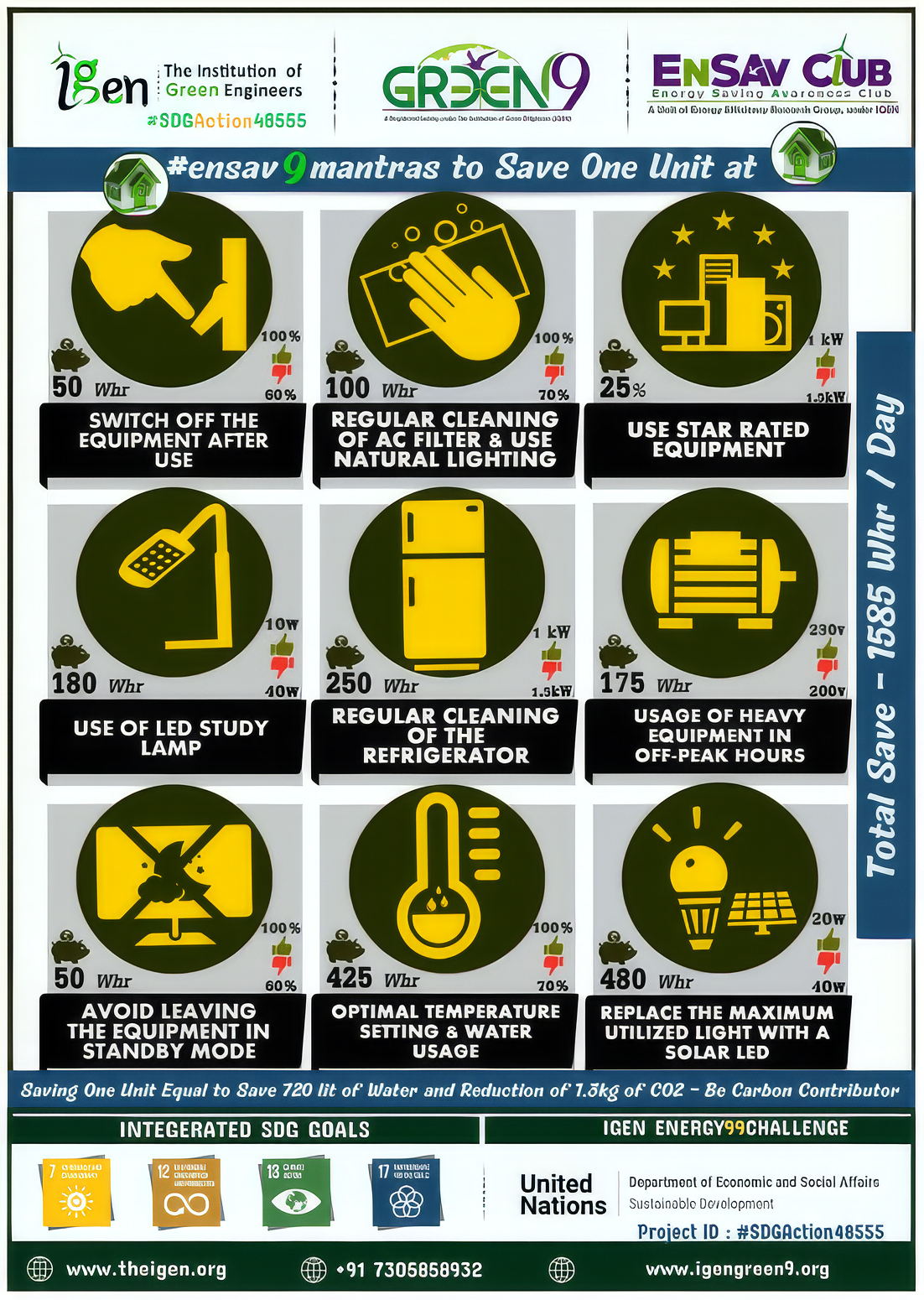
This is where #ENSAV9MANTRAS (simple 9 mantras can save one unit per day at home), researched, founded, and formulated by Dr. L. Ramesh and Dr. J. Balamurugan, emerges as a powerful student-led energy conservation initiative—demonstrating that meaningful climate action can begin with simple daily habits, driven by community engagement rather than policy mandates alone.
Students as Energy Messengers: ENSAV9MANTRAS was built on a simple insight—students are trusted voices within families and neighbourhoods. When young people explain energy-saving practices to parents, relatives, and neighbours, the message carries credibility and emotional connection.
Under the IGEN ENERGY99 Challenge, trained students committed to engaging 99 households each, introducing nine practical energy-saving actions that require minimal or no financial investment. These actions focused on routine electricity use, appliance care, and the often-overlooked link between water use and energy consumption.
From Awareness to Action
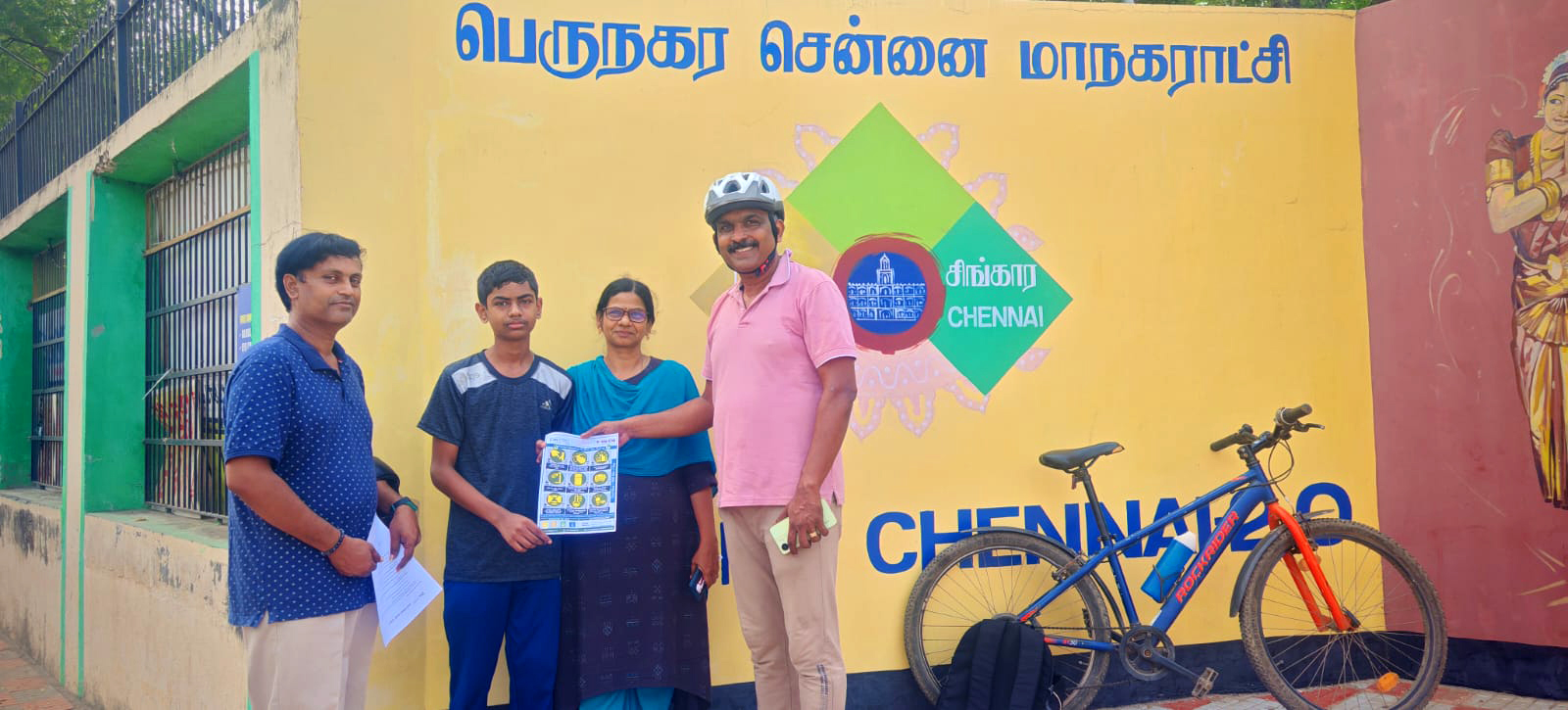
Unlike conventional awareness campaigns that stop at information sharing, ENSAV9MANTRAS emphasised demonstration and follow-up. Students visited homes, explained why certain practices waste electricity, and showed how small changes—such as switching off standby power or improving ventilation around appliances—could reduce energy bills.
Communication materials were kept simple and local-language friendly. Visual aids, household conversations, and peer examples proved far more effective than posters alone.
Between 2022 and 2024, the initiative reached more than 33,000 households across urban and semi-urban communities. Surveys and electricity bill comparisons revealed that over 75 per cent of households adopted at least six of the nine recommended practices.
On average, participating households recorded annual savings of up to 3,650 units of electricity, translating into significant cost reductions. The associated environmental benefits included lower carbon emissions (around 4.7 tonnes of CO₂ annually per household) and reduced water consumption, underscoring the strong water–energy linkage.
These results reinforce a key insight: behaviour-led interventions can deliver substantial energy savings without requiring new infrastructure or capital investment.
Co-benefits Beyond Electricity
Households reported additional benefits such as lower appliance repair costs, longer equipment lifespan, and increased awareness of resource use. In several neighbourhoods, women emerged as informal energy champions, sharing conservation practices with neighbours and monitoring household routines.
For students, the initiative functioned as experiential learning. Participants developed leadership, communication, and problem-solving skills while gaining a grounded understanding of sustainability as a daily practice rather than an abstract concept.
Why Personal Engagement Works
Digital campaigns supported the outreach, but the strongest results came from face-to-face interaction. Personal conversations built trust and accountability, while recognition of participating households created positive social reinforcement. Energy conservation gradually evolved into a shared community norm rather than an externally imposed requirement.
ENSAV9MANTRAS directly contributes to SDG 7 (Affordable and Clean Energy), SDG 12 (Responsible Consumption and Production), and SDG 13 (Climate Action). Its measurable outcomes and replicable design led to its recognition by the United Nations Department of Economic and Social Affairs (UN DESA) as SDG Action #48555.
A Scalable Model for India
The initiative demonstrates how educational institutions can become hubs of community energy action. Integrating behaviour-based energy modules into school and college programmes, supported by local governments and utilities, could significantly reduce household electricity demand nationwide.
As India works towards a low-carbon future, ENSAV9MANTRAS highlights a simple but powerful truth: energy transition is not only about how energy is generated, but also about how it is used every day.
“Change begins within—align the heart, balance the Panchabhutas, and act for climate control.”
— Dr. L. Ramesh

Dr. L. Ramesh is President of The Institution of Green Engineers (IGEN) and Professor at Dr MGR Educational and Research Institute works on community-led energy efficiency and SDG-aligned climate action initiatives across India. Ramesh Profile https://vidwan.inflibnet.ac.in/profile/62019
Evidence and Public Documentation of #ENSAV9MANTRAS Action
The implementation and impact of the #ENSAV9MANTRAS initiative are supported by publicly verifiable evidence, including photographic records, video documentation, and independent digital visibility.
- Photo Documentation:
https://www.facebook.com/groups/3437435266370402/media/photos - Video Documentation:
https://www.facebook.com/groups/3437435266370402/media/videos - Public Visibility & Independent References:
The initiative is widely indexed online and can be verified through a Google search using the hashtag #ENSAV9MANTRAS:
https://www.google.com/search?q=%23ensav9mantras
These links provide transparent proof of community engagement, student participation, and on-ground implementation of the energy conservation actions described in the article.