
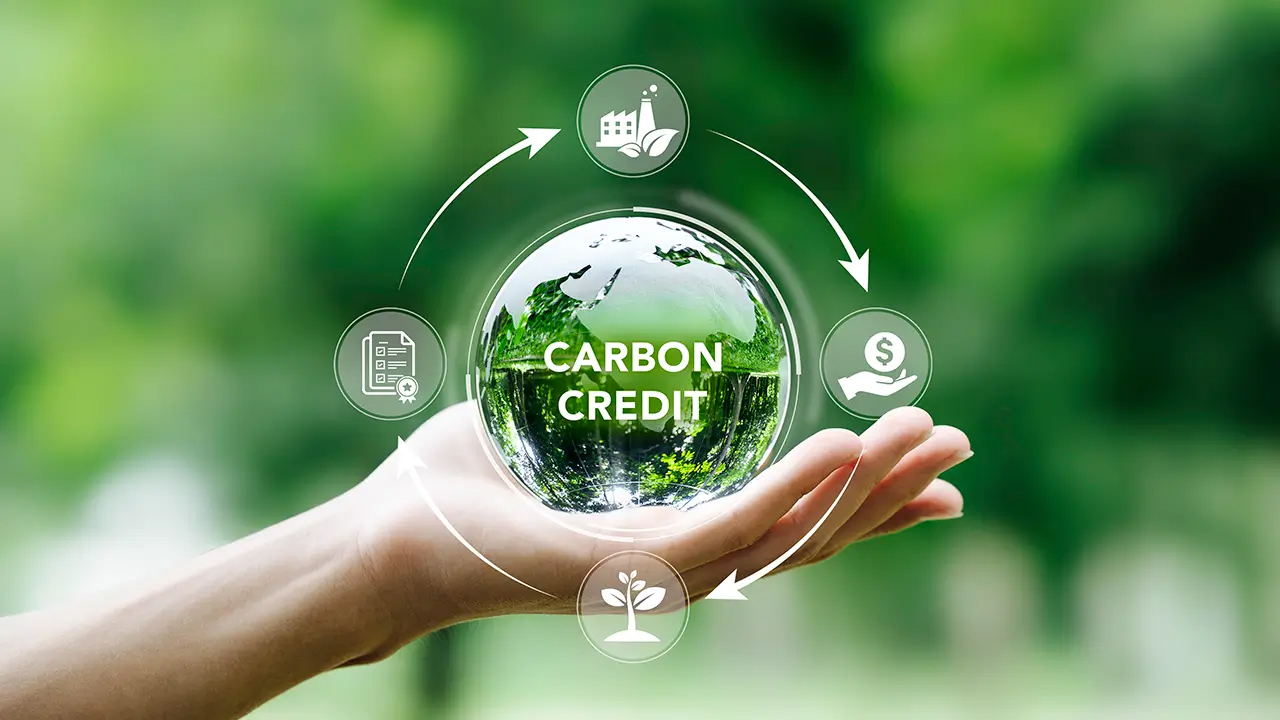
Voluntary carbon markets (VCM) have come a long way. Once viewed as a patchwork of well-intentioned but inconsistent efforts, these markets are now integral to how corporations offset emissions and demonstrate environmental commitment. But with scale came scrutiny. The carbon market has long struggled with credibility issues like fragmented data systems, varying definitions of credit quality, and occasional accusations of greenwashing. Against this backdrop, CDOP and the revised SBTi Net-Zero Standard emerge as corrective tools, setting a foundation for a more trustworthy and rigorous marketplace.
The VCM has experienced steady growth in recent years, though concerns over quality persist. In 2024, the market was valued at around US $1.4 billion, a slight decline from previous years, underscoring a broader stagnation in demand amid scrutiny over project quality. Despite this plateau, forecasts remain optimistic: the market is projected to expand from US $1.7 billion in 2024 to nearly US $15.7 billion by 2034, at a robust 25% annual growth rate. These projections suggest that a credible, high-integrity market could unlock vast opportunities. However, current credibility challenges such as opaque methodologies and weak third-party assurance threaten investor and corporate confidence.
What Is the Carbon Data Open Protocol (CDOP)?
Launched in March 2025 by a coalition including RMI, Sylvera, and S&P Global Commodity Insights, the CDOP is a voluntary, open-source framework designed to standardize how carbon credit data is reported and shared. Its core objectives include:
- Harmonizing taxonomies and definitions used across platforms
- Enabling interoperability between different carbon registries and data systems
- Improving credit comparability across geographies and methodologies
- Aligning with Article 6 of the Paris Agreement, which governs international emissions trading
By doing this, CDOP aims to reduce confusion and eliminate bad actors from the market. It empowers buyers, investors, and regulators with traceable, verifiable, and transparent data. Importantly, it also helps establish a common language in a space previously marked by fragmentation.
The Legal and Strategic Implications
For corporations engaging in carbon credit transactions whether as buyers, sellers, or verifiers, CDOP brings both opportunity and responsibility. Transparency, while a sign of integrity, also exposes weak spots. Companies that relied on vague climate claims or credits of questionable quality may now face increased legal and reputational risks. Contractual obligations will need revisiting. Data rights, third-party verifications, and audit trails must be clearly defined. This could especially impact multinational firms navigating diverse regulatory landscapes.
CDOP doesn’t just create a framework, it pushes for data discipline. And as carbon trading matures, such discipline could very well become the gold standard.
SBTi’s Net-Zero Standard 2.0
The Science Based Targets initiative (SBTi) has long served as a cornerstone for validating corporate climate targets. But its latest draft, Version 2.0, released for public comment in April 2025, represents a meaningful leap toward operational accountability. Key updates include:
- Distinct target setting for Scope 1 and Scope 2 emissions
- Enhanced guidance based on company size and geography
- Emphasis on annual progress tracking
- Conditional use of carbon credits only for residual emissions after deep reductions
The earlier version discouraged the use of carbon offsets, particularly for short-term targets. In contrast, Version 2.0 allows their limited use provided companies first make verifiable, deep reductions within their own operations. It’s a move toward “reduction first, compensation later”.
A Tighter Net Around Greenwashing
Together, CDOP and SBTi 2.0 are tightening the web around corporate climate accountability. Disclosures must now be rooted in data, third-party verified, and science-aligned. Loosely defined net-zero claims and over-reliance on carbon offsets will no longer cut it. For businesses, this presents a twofold challenge:
- Operational: Updating emissions tracking systems, supplier agreements, and ESG governance frameworks.
- Legal: Ensuring public claims align with evolving standards to avoid regulatory backlash.
Professionalizing the Voluntary Market
Perhaps the most profound impact of these frameworks is the professionalization of the voluntary carbon market. CDOP’s alignment with Article 6 of the Paris Agreement means voluntary systems are inching closer to compliance-grade rigor. This has far-reaching implications:
- Buyers will demand only the highest-quality credits with auditable value.
- Project developers must embrace data transparency and third-party validation as non-negotiable.
- Investors will gravitate toward companies with verifiable, science-backed climate disclosures.
- Lagging participants may face exclusion from capital markets and procurement networks.
For high-integrity players, this is an opportunity to differentiate. For others, it is a wake-up call.
What It Means for India and the Global South
Emerging markets, including India, play a crucial role in supplying high-quality carbon credits through afforestation, renewable energy, and community-driven mitigation projects. However, these markets often face data and infrastructure challenges. CDOP and SBTi offer a chance to bridge that gap. Standardized protocols and global benchmarks create a level playing field, where credit quality is judged by evidence not geography. For Indian firms, this is both a challenge and an incentive to scale with transparency.
Looking Ahead
The carbon credit ecosystem is undergoing a credibility revolution. The days of vague climate pledges and opaque data are ending. In their place, we are seeing the rise of quantifiable, auditable, science-based climate action. CDOP and SBTi 2.0 are not just technical frameworks, they are trust-building mechanisms. In a world where environmental claims influence investor confidence, consumer trust, and regulatory scrutiny, credibility is currency.

For businesses, the message is clear: climate action must now be measurable, verifiable, and accountable. This evolution not only strengthens the market but also aligns with the global commitment of enabling climate action that is as real and lasting as the problem it seeks to solve.
This author is the Chairman and Managing Director, EKI Energy Services and President Carbon Markets Association of India.