
In the health category, Jade, an SME from the UAE, was honoured for reimagining neurodevelopmental screening through AI and play. Its gamified platform, combining cognitive assessments, eye-tracking, and personalised learning, is now used in over 450 institutions across 179 countries.
By reducing diagnostic wait times and improving engagement, Jade has already supported more than 180,000 children worldwide and is setting a new benchmark for inclusive early intervention.
In the Food category the award went to N & E Innovations of Singapore, recognised for its breakthrough biodegradable antimicrobial packaging and coatings that extend food shelf life while tackling waste at its source.
Made from upcycled food waste and plant-based ingredients, the company’s patented technology delivers 99.9% antimicrobial effectiveness, achieving bacterial counts 4.5 times lower than conventional materials. Food-safe, compostable, and circular by design, more than 400,000 sustainable packs have already reached consumers.
In the Energy category, Switzerland’s BASE Foundation was recognised for transforming how communities access sustainable cooling. Its Cooling-as-a-Service model eliminates upfront costs and makes low-carbon cooling both efficient and affordable. Operating in 68 countries, BASE has created 2,500 jobs, while its model saves 130 GWh of electricity and prevents 81,000 tonnes of CO₂ emissions per year, demonstrating how market-based innovation can scale environmental impact.
The Water category recognised Stattus4, an SME from Brazil, whose AI- and IoT-enabled technology helps utilities detect and fix leaks with unprecedented speed and precision. Monitoring more than 5,000 kilometres of distribution networks and identifying over 22,000 potential leak points.
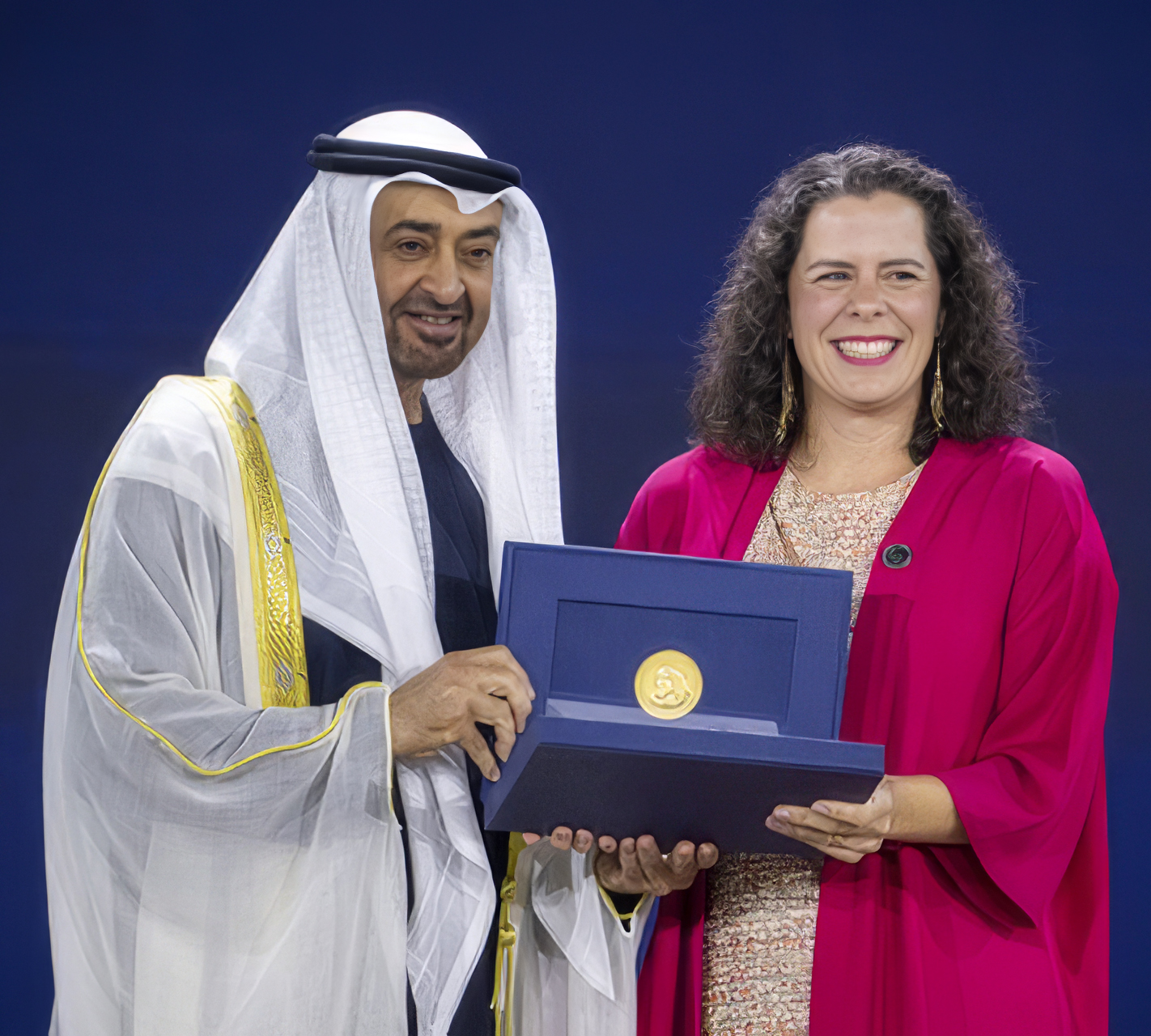
Stattus4 saves around 5.56 billion litres of water every day, strengthening water security for over four million people and transforming the efficiency of urban water systems.
In the Climate Action category, Build up Nepal, a nonprofit organisation from Nepal, was celebrated for reinventing brickmaking as a tool for climate resilience and economic empowerment.
To date, the organisation has produced over 3.3 million earthquake-resistant eco-bricks and supported the construction of more than 12,000 resilient homes, creating nearly 2,000 green jobs, housing 58,000 people, and avoiding 110,000 tonnes of CO₂ emissions in the process.
The Zayed Sustainability Prize continues to empower the next generation of sustainability leaders through its Global High Schools category, enabling youth to turn local challenges into practical solutions that benefit their communities.
Each year, six high schools representing the world’s regions receive up to US $150,000 to implement innovative, student-led projects that create meaningful social, economic, and environmental impact. To date, the Prize’s 56 previous Global High Schools winners have impacted the lives of over 56,599 students and 480,660 people across the globe.
The 2026 recipients of the Global High Schools awards are Mamawi Atosketan Native School (Canada), representing The Americas; Kyanja High School (Uganda), representing Sub-Saharan Africa; Al Rajaa School for the Deaf (Jordan), representing the Middle East & North Africa; Bodrum Anatolian High School (Türkiye), representing Europe & Central Asia; Faafu Atoll Education Center (Maldives), representing South Asia; and Ruamrudee International School (Thailand), representing East Asia & Pacific.
Since its establishment in 2008, the Prize has become a catalyst for impact, rewarding small and medium-sized enterprises, nonprofit organisations, and high schools that are addressing critical challenges across the six categories of Health, Food, Energy, Water, Climate Action, and Global High Schools. Through its 128 winners, the Prize has impacted over 411 million lives.
This cycle, a record 7,761 submissions were received from 173 countries, reviewed through a rigorous, multi-stage evaluation process by technical experts, the Selection Committee, and a distinguished Jury chaired by H.E. Ólafur Ragnar Grímsson, former President of Iceland.