

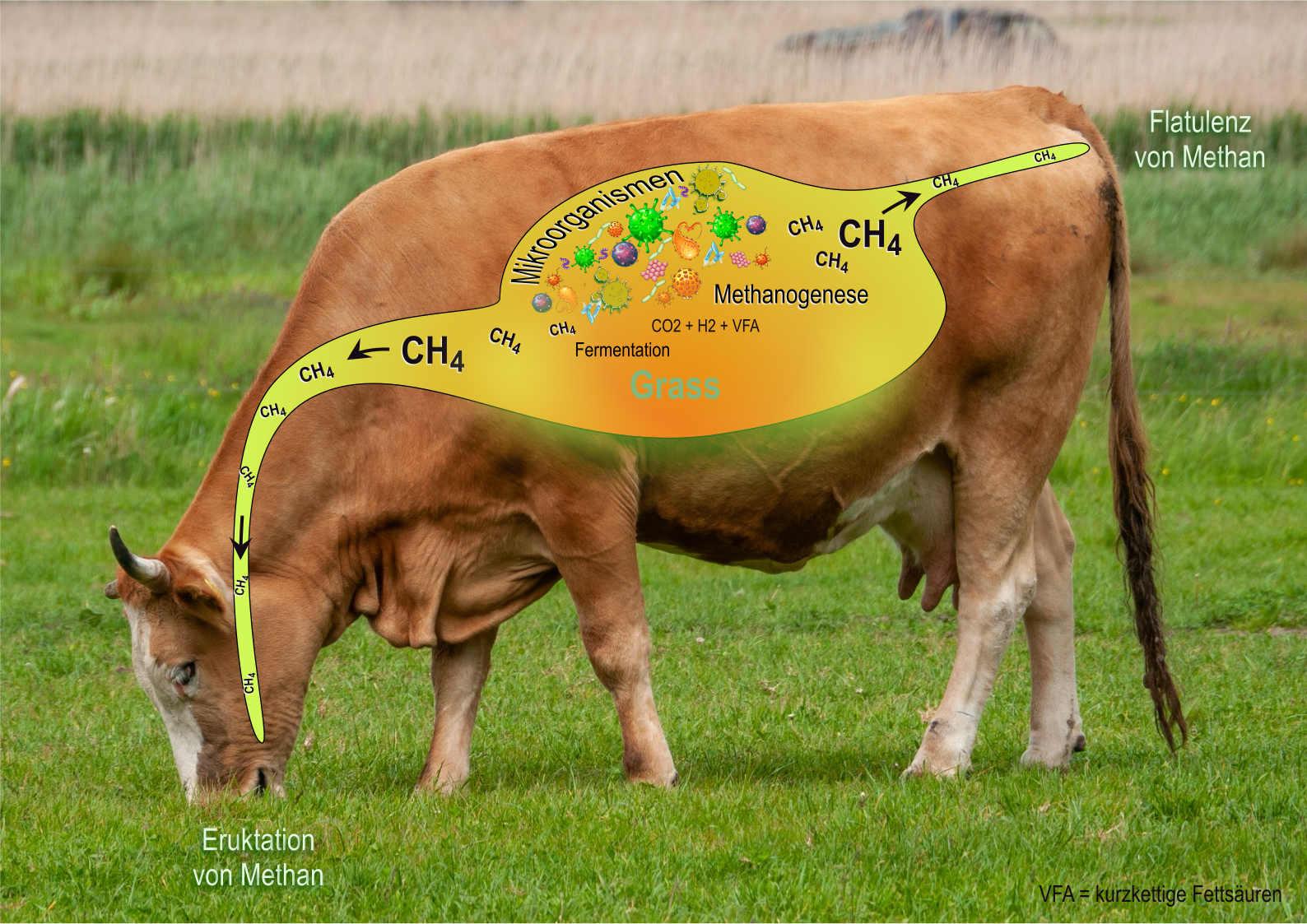
When climate change discussions mention cows, methane emissions from cattle often get the blame. Yet, methane output is largely a consequence of how humans have industrialized cattle farming for meat and milk.
The United Nations Food and Agriculture Organization (FAO) estimates livestock—especially beef and dairy cattle—contribute roughly 35–40% of human-driven methane emissions (about 6% of total global greenhouse gases). Methane is a potent greenhouse gas, trapping more than 80 times the heat of carbon dioxide over 20 years. Large-scale industrial cattle systems, producing massive herds fed grain-heavy diets, generate methane emissions many times higher than natural grazing systems.
How Humans Made Cows Methane Machines
In ancient India, cows lived integrated into balanced rural ecosystems, grazing naturally with small herds, moderate milk yields, and milk given only after the calf fed. This traditional model, emulated today by pioneers like Akshayakalpa Organic, features free-roaming cows, small cooperative herd sizes, and natural pasture feeding, all helping keep methane emissions naturally low.
Contrast this with today’s factory-farmed cows, which produce six to ten times more milk due to hormones, confinement, and grain-heavy feed, resulting in significantly elevated methane emissions and ecological damage.
Lactose Non-Persistence: The Global Norm
Biologically, mammals consume milk only during infancy, as lactase—the enzyme needed to digest lactose—declines after weaning. Humans developed lactase persistence—continued lactase production into adulthood—only in select populations over the last 5,000–10,000 years, primarily among groups with dairy farming traditions.
According to the U.S. National Institutes of Health (NIH), approximately 65% of the global adult population is lactose non-persistent, meaning lactose intolerance is actually the norm worldwide. Yet, cultural perceptions often treat lactose intolerance as abnormal, overlooking this biological majority.
Full-fat dairy consumption has been linked to elevated LDL (“bad”) cholesterol, emphasizing the need for healthier, diversified dairy alternatives.
Startup Opportunity: Blended Plant-Based Milks
Despite this clear need, startups have yet to fully tap into the potential of blended plant-based milks using diverse, nutrient-rich ingredients like moringa, which offers more calcium than dairy or oranges. Such blends promote biodiversity, enhance nutrition, support farmers through gradual transition, and align with global dietary shifts.
Public awareness of this opportunity remains surprisingly low—an obstacle policymakers and entrepreneurs must urgently address.
Meat Supplements in Dairy: Risks and Regulations
In some countries—including the US and China—meat-derived protein supplements are used in dairy cattle feed to boost growth. This practice is not legal in India or the European Union, due to health and ethical concerns.
Historical lessons from mad cow disease (Bovine Spongiform Encephalopathy) underscore the dangers of feeding herbivorous cows meat products, which disrupts natural biology and pose risks to public health. It is unwise and risky to convert naturally herbivorous cows into meat-eaters.
The Zeolite Methane Capture Opportunity
Zeolite, a natural porous mineral commonly found in cat litter, has been shown by MIT researchers to oxidize methane into carbon dioxide when combined with certain catalysts, substantially reducing methane emissions.
Startups can harness a circular model: collect and regenerate used cat litter zeolite from households, repurposing it for methane capture on farms and barns. This community-driven approach can create a scalable climate solution rooted in accessible technology.
Bridging Ancient Wisdom and Modern Innovation
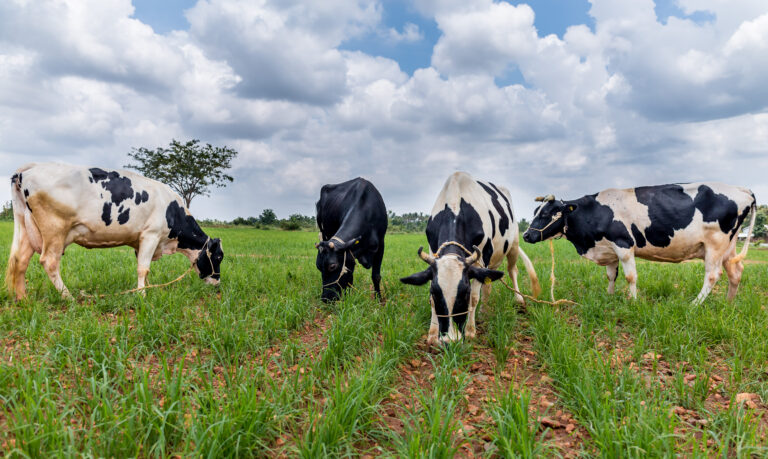
Ayurveda emphasized moderation, teaching that milk is truly nourishing only when humans take it after the calf has been fully fed. Such wisdom guided traditional practices that naturally lowered methane emissions—through healthier digestion in animals, maintaining small herds, and using manure to enrich soil carbon.
The Akshayakalpa Organic model, with free-roaming cows, cooperative ownership, and natural grazing, is a contemporary example showing how respecting natural cycles can significantly reduce emissions.
A 2024 peer-reviewed study in Frontiers in Sustainable Food Systems found that grazing systems using diverse cover crops instead of conventional pastures achieved up to a 29% reduction in daily methane emissions and a 36% reduction in methane yield (although conducted on beef cattle, the findings are relevant to dairy systems with similar grazing and forage practices). This underscores the climate benefits of such approaches alongside gains in animal welfare and farmer prosperity.
In a regenerative farming system, the cow can become a net positive contributor to the land, much like the whale is to the oceans with its nutrient-rich fecal plumes. Just as whales fertilize phytoplankton that capture vast amounts of carbon, cows—through manure and preparations like Jeevamrutha—feed soil microbes, boost organic carbon, and regenerate degraded soils.
This creates a cycle where their presence restores rather than depletes the environment. For this reason, and many others rooted in culture, tradition, and ecology, the cow has long been central to the farmer’s livelihood in India—a keystone species in the agricultural ecosystem and revered as sacred.
Reducing Beef Consumption for Climate and Health
Beef has the highest carbon footprint among foods: producing one kilogram can emit 20–60 kilograms of CO₂-equivalent gases. Globally, about 300 million cattle are slaughtered annually, reflecting the massive scale of resource use and emissions linked to beef production.
Studies, notably by the University of Oxford, demonstrate that replacing beef with plant-based proteins can reduce emissions by up to 90%, while improving public health and aligning diets with ethical values.
Research Imperative
A critical research gap remains: direct, controlled comparisons between free-range, grass-fed cows whose surplus milk is taken only after the calf is fed and factory-confined cows fed high-protein grain diets and, in some countries, meat supplements. Researchers should quantify:
- The number and methane volume of their burps (eructations) per day
- Changes in their rumen microbiota
- Resulting milk composition and nutritional profile
- Long-term animal health outcomes
Such studies would provide the empirical basis to validate traditional low-emission systems, refine methane-reduction strategies, and shape evidence-driven policy. Without these head-to-head comparisons, global climate targets and dairy reform risk being guided by assumption rather than science.
A Policy-Driven Path Forward
The public health and climate challenges are in plain sight—and the solutions are within reach. By combining:
- Zeolite methane capture via industrial and household-sourced routes
- Expansion of wisdom-based dairies like Akshayakalpa Organic
- Rapid scale-up of blended plant-based milks and plant-based food alternatives that mimic beef
…we could potentially halve cattle-related methane emissions within two decades. An additional 10–15% gain could come from reducing grain demand for feed, easing fertilizer, transport, and land clearing impacts.
Policymakers Should
- Support startups and infrastructure for zeolite recycling and methane capture.
- Fund R&D and incentives for multi-ingredient plant-based milks and beef alternatives—raising nutritional diversity and consumer awareness.
- Launch education campaigns clarifying that lactose non-persistence is the biological norm and promoting diverse dairy alternatives.
- Establish international standards for meat supplements in cattle feed, or at minimum, impose a moratorium until long-term safety and environmental studies are completed, with improved labeling for transparency.
Developing mathematical models using AI can help validate projections and optimize these strategies. This integrated blueprint—where ancient wisdom meets modern innovation—can protect the climate, improve health, and sustain rural livelihoods without abrupt disruption to dairy economies.

Ram Ramprasad holds a graduate degree in International and Development Economics from Yale University and has extensive experience in global healthcare marketing. He is a vocal advocate for sustainability and has authored numerous essays and articles on climate, agriculture, and public health strategies blending ancient wisdom with modern innovation.
Ram’s previous articles published in SustainabilityNext
Integrated Offshore Water and Wind Solution for India’s Coastal Cities
Gut and Soil Microbial SustainAbility Bridges Science and Ancient Indian Wisdom
From Waste to Wealth: Rebranding Sewage Treatment Plants (STPs) to Resource Recovery Plants (RRPs)
The Hidden Crisis with Our Beds
Startup ideas for Sustainable Cremation and Burial Solutions in India
How India’s Agriculture Can Save 200 Billion Cubic Meters of Water
Ten Powerful Reasons for Declaring Moon A Living Entity
Sustainable Wind Turbines: Balancing Bird Protection and Agriculture
A Holistic Water Strategy for India
How India Can Leverage its GST Model for Building a Sustainable Future
A Toolkit for India’s Green Transition
Green Building Strategy – Integrating Innovations from East and West
Eat Less Fish, Save the Planet
Startups are Working Hard for a Plastic-free World
Hydrogen More Harmful Than Fossil Fuels
Tech Startups Can Make India Water Rich
Measure How Basic Elements are Doing, Not Just GDP
A Radical Strategy for A Greener India – The Story of Kusha






[…] Common Sense Strategies to Reduce Methane Emissions from Cattle […]
[…] Common Sense Strategies to Reduce Methane Emissions from Cattle […]