

Beyond Industrial Self-Reliance
As India charts its path toward self-reliance, a critical question arises:
Are we strengthening only our industries, or are we nurturing the Earth itself?
Six of the nine planetary boundaries identified by scientists are already breached. Humanity is living on borrowed ecological credit, yet economic policies continue to operate with a mechanistic, consumption-driven idea of “self-reliance.”
India’s celebrated slogan, Ātma Nirbhar Bharat, is often interpreted narrowly — as industrial independence, supply-chain resilience, and technological autonomy. But true self-reliance must be rooted in nature: in the care of soil, water, fire, air, and space — the five foundational elements of life.
India’s knowledge systems offer an enduring alternative: Ātma Bhūmi Nirbhar Bharat — self-reliance anchored in the health of the Panchamahabhutas.
Unlike conventional Ātma Nirbhar thinking, which mirrors a linear economic model of take, make, and waste, Ātma Bhūmi Nirbhar fosters a circular economy where every “waste” becomes a resource for another element, enriching rather than harming it, while safeguarding biodiversity.
Without restoring balance in these elements, neither human flourishing nor sustainable prosperity is possible.
From Self-Reliance to Elemental Care
The distinction matters. In Western industrial modernity, self-reliance means producing, consuming, and trading to minimize dependency — with nature as a resource to dominate.
By contrast, Indic thought recognizes the human being and the cosmos as mirrors of each other:
Yat pinde tat brahmande — as in the body, so in the universe.
Humans are composed of the same five elements that sustain Earth:
- When soil is degraded, stability and nourishment (Mulādhāra, the root chakra) are shaken.
- When water is polluted, creativity and flow (Svādhiṣṭhāna, sacral chakra) falter.
- When fire is exploited recklessly, vitality and transformation (Manipura) diminish.
- When air is poisoned, breath and compassion (Anāhata) suffer.
- When space is congested or desecrated, consciousness and expression (Viśuddha and beyond) lose clarity.
An India that is merely self-reliant in industrial or technological terms is insufficient.
Only a nation that is element-reliant, where governance aligns with the care of the Panchamahabhutas, can achieve true sustainability, health, and prosperity.
Chakras, Elements, and Cosmic Interdependence
Ancient India encoded this wisdom in the Vedas and mapped it onto the human body through the chakras. Each chakra corresponds to an element, illustrating that physical reality and spiritual evolution are inseparable.
Take the second chakra, Svādhiṣṭhāna, symbolized by a crescent moon resting on water. The moon does not merely symbolize water — it governs its flows.
Lunar rhythms regulate:
- Tides
- Fertility cycles
- Sap movement in trees
- Subtle fluid balances in the human body
Modern science increasingly confirms this principle: water systems on Earth are deeply intertwined with cosmic rhythms.
Exploiting the moon for mining or extraction is therefore not merely a space policy question. It has direct consequences for water cycles that sustain all life on Earth.
Disturb the moon’s role, and we disturb the Svādhiṣṭhāna chakra itself — creativity, emotional balance, and regenerative capacity all falter.
This reveals the profound macrocosm–microcosm connection. What happens in the cosmos reverberates in our bodies and in planetary health.
India’s civilizational wisdom makes this explicit: caring for Earth is inseparable from caring for ourselves.
Governance Through the Five Elements
If the Panchamahabhutas are the true foundation of life, why is governance not organized around them?
Today, soil is fragmented across Agriculture, Forestry, Rural Development, AYUSH, and other departments. Water alone has received a dedicated ministry — Jal Shakti. But why stop there?
Imagine a governance architecture where each element has its own dedicated ministry, each advancing an Ātma Bhūmi Nirbhar Bharat strategy:
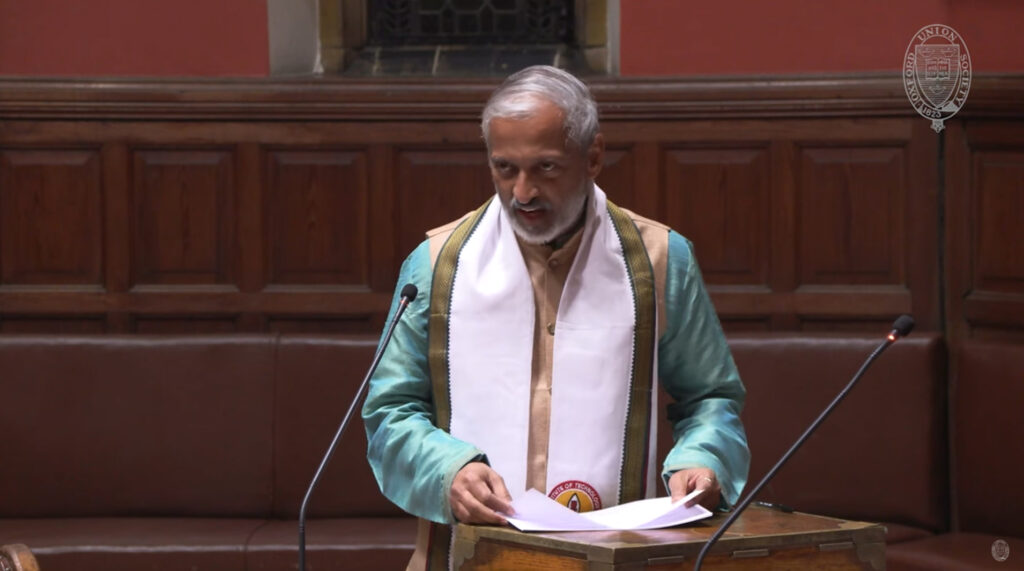
- Soil: Integrating agriculture, land restoration, regenerative farming, and biodiversity stewardship.
Example: A strategy to maximize plant-based diets and minimize dependence on animal agriculture, including dairy, could enhance public health, reduce GHG emissions, and improve soils and agroforestry.
We must revise messaging from “infrastructure” to “Ecostructure”. Interesting podcast by Dr. Sailesh Rao on animal agriculture and it’s impact on land, water, and GHG emissions. - Water: Managing rivers, groundwater, rain-harvesting, and watersheds.
Example: Byproducts from wastewater can be used to build permeable roads to recharge dangerously low groundwater levels while avoiding excessive ocean discharge.
We must revise messaging from “Sewage Treatment Plants (STPs)” to “Resource Recovery Plants (RRPs).” - Fire/Energy: Advancing diverse renewable and decentralized energy systems, bioenergy, and efficiency measures.
Example: Households could install bird-friendly rooftop wind turbines and adopt metal-free, biodegradable battery technologies derived through microbial processes rather than mining rare earths. My article on a planet centric energy strategy: https://sustainabilitynext.in/a-planet-centric-energy-strategy-for-india/ - Air: Implementing clean air policies, sustainable mobility, afforestation, and climate-sensitive urban design.
Example: GST could be set at 0% for EV auto-rickshaws and ride-share platforms, while higher slabs apply to private car ownership. - Space: Stewarding the cosmic commons, regulating satellites, ensuring planetary protection, and developing outer-space ethics.
Example: India could revisit the Artemis Accords on moon mining. If trace amounts of methane can alter Earth’s atmosphere, depletion of lunar elements could analogously disturb cosmic equilibrium.My article on ten powerful reasons to declare moon a living entity: Such a model would enable India to act holistically rather than in fragmented silos.

Ātma Bhūmi Nirbhar Bharat thus becomes an organizing principle — integrating policy, science, and culture into a unified vision.
Measuring What Matters: The Environmental Health Index
Governance cannot succeed without measurement. As the adage goes, we manage what we measure.
Current sustainability metrics — GDP, carbon footprints, or even the UN SDGs — do not adequately capture elemental health.
In my article for Earth.org, I proposed the Environmental Health Index (EHI): a composite measure assessing the regenerative health of each of the five elements.
By tracking:
- Soil fertility
- Water quality
- Energy balance
- Air purity
- Integrity of space systems
India can develop a transparent scorecard of planetary well-being.
Just as a doctor monitors blood pressure or organ function, policymakers can respond to falling scores in soil, water, or air. The EHI makes ecological health actionable, giving India a tool to demonstrate global leadership not just in economic growth, but in planetary stewardship.
My article on EHI: https://earth.org/biomakers-planetary-health/
GST: The Most Underestimated Economic Lever for a Circular Economy
India holds a unique instrument few nations possess — the Goods and Services Tax (GST). Its multi-slab system can subtly yet powerfully incentivize elemental health and sustainable consumption.
- Goods and services that restore or protect the elements — millets, organic produce, clean technologies, renewable energy systems, and water-saving innovations — can be placed in 0% or 5% slabs.
- Goods that degrade the elements or public health — ultra-processed foods, fossil-fuel vehicles, polluting chemicals, and plastics — can be placed in higher slabs.
Such a model transforms GST from a revenue instrument into a guardian of elemental health, aligning fiscal policy with Ātma Bhūmi Nirbhar Bharat.
No other large democracy wields such a flexible tool for planetary stewardship — giving India a model the world can emulate.
A New Civilizational Compass
The world urgently needs a model that transcends mechanistic economics. India has the civilizational capital to provide it.
The Vedic insight that the microcosm mirrors the macrocosm is not mystical abstraction — it is practical governance for a planet in crisis.
In my book Creating a Green and a Cultural Economy, I argue that humanity must reorder its developmental priorities:
Culture
Sustainable Lifestyle
Ecology
Economics
When culture is rooted in reverence for nature, it shapes sustainable lifestyles.
When these lifestyles flourish, ecology regenerates.
When ecology thrives, the economy becomes circular and life-supporting.
Sadly, this sequence has been reversed in the modern world — economics now dominates, while ecology and culture are treated as afterthoughts. The result is imbalance, both ecological and moral.
Ātma Bhūmi Nirbhar Bharat seeks to restore this lost order. It begins with culture — India’s civilizational wisdom that unites body, mind, and spirit with the five elements of nature. From this foundation arises a lifestyle that values balance and restraint, nurturing ecological health and, in turn, sustainable prosperity.
Every spiritual or religious tradition, if rightly understood, affirms this principle: self-realization and planetary stewardship are inseparable.
When a strategic policy embraces diversity, decentralization, and human and elemental well-being, the natural world responds in kind. This vision integrates culture, ecology, and economy into one continuum of spiritual stewardship.
By placing culture at the root and economics at the canopy, India can pioneer a regenerative model of development — one that honors its civilizational heritage while guiding the world toward a sustainable future. True prosperity arises not from exploiting the elements but from honoring them.
If India leads with this elemental and cultural compass, it can show that real self-reliance is not dominion over resources but guardianship of the very forces that sustain life.
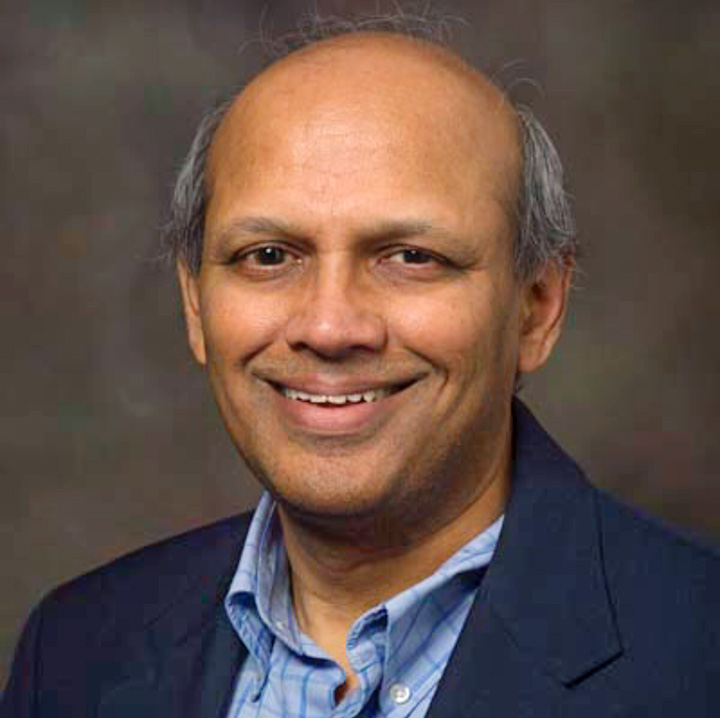
Ram Ramprasad is a sustainability advocate and author with graduate degrees from Madras University and Yale University. He previously served as Global Marketing Director for a multi-billion-dollar company in the United States. His work explores how India’s ancient wisdom can inform modern governance, environmental stewardship, and social transformation. His essays have been published in Earth.org, TerraGreen, Sustainability Next, and other international platforms.
Ram’s previous articles published in SustainabilityNext
Why India Needs a Millet Revolution
Common Sense Strategies to Reduce Methane Emissions from Cattle
Integrated Offshore Water and Wind Solution for India’s Coastal Cities
Gut and Soil Microbial SustainAbility Bridges Science and Ancient Indian Wisdom
From Waste to Wealth: Rebranding Sewage Treatment Plants (STPs) to Resource Recovery Plants (RRPs)
The Hidden Crisis with Our Beds
Startup ideas for Sustainable Cremation and Burial Solutions in India
How India’s Agriculture Can Save 200 Billion Cubic Meters of Water
Ten Powerful Reasons for Declaring Moon A Living Entity
Sustainable Wind Turbines: Balancing Bird Protection and Agriculture
A Holistic Water Strategy for India
How India Can Leverage its GST Model for Building a Sustainable Future
A Toolkit for India’s Green Transition
Green Building Strategy – Integrating Innovations from East and West
Eat Less Fish, Save the Planet
Startups are Working Hard for a Plastic-free World
Hydrogen More Harmful Than Fossil Fuels
Tech Startups Can Make India Water Rich
Measure How Basic Elements are Doing, Not Just GDP
A Radical Strategy for A Greener India – The Story of Kusha