
The thinktank Ember reported that for the first half of 2025 solar and wind grew so fast that they covered all the growth in demand for electricity so far this year, with room to spare. Analysts are calling this an epochal moment. It demonstrates that the clean energy transition is real, something that sounded mambo jumbo even three years ago.
“The fall overall of fossil may be small, but it is significant,” said one of the Ember researchers. “This is a turning point when we see emissions plateauing.” Fossil fuel use for electric generation fell 2 percent in China, and dipped in India as well.
Unfortunately, while the world celebrates this moment, the United States is sliding back – growth in electric demand outpaced new renewable supply. The Trump administration has declared an all out war on clean energy.
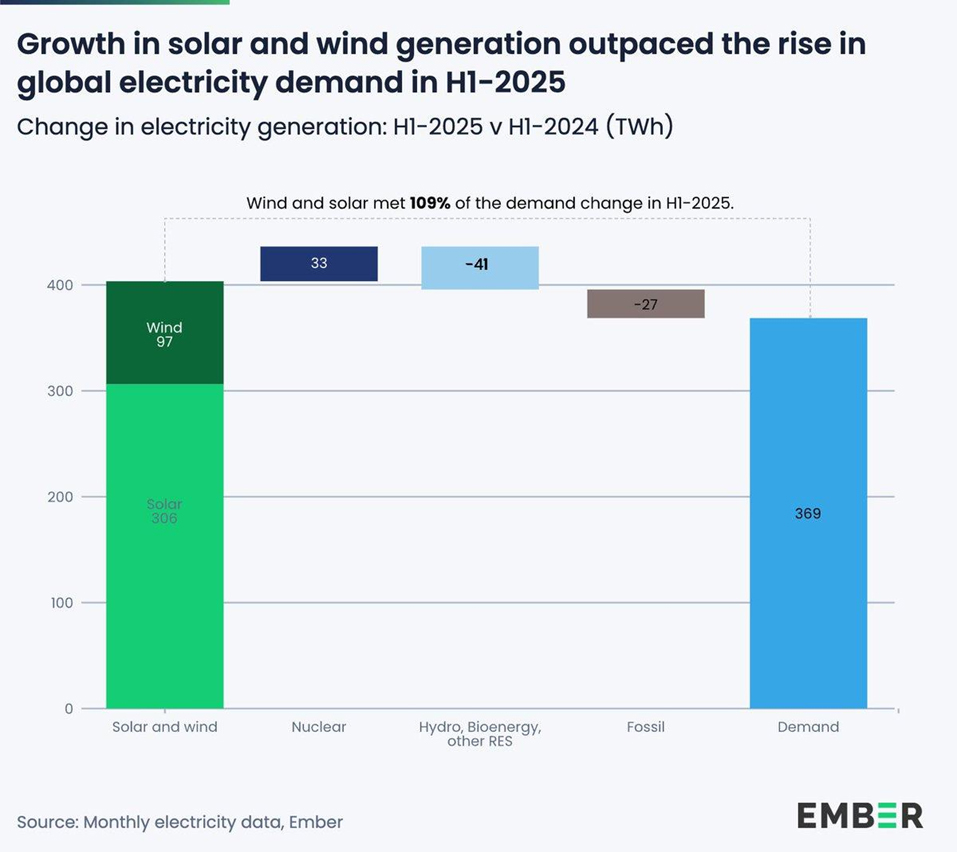
“The forecast for the United States is revised down by almost 50%” from a year ago, the report states, after the Trump administration phased out federal renewable energy tax credits ahead of schedule, imposed severe import restrictions on renewables industries, suspended new offshore wind leasing, and curtailed wind and solar leasing on federal lands.
New data shows that China is now exporting more clean energy than the U.S. is exporting dirty energy. The US, which has positioned itself as a major fossil fuel exporter, sold $80 billion in oil and gas abroad through July, the last month with data available. China exported $120 billion in green technology over the same period.
Carbon Offsets an Abysmal Failure
A big new study finds that carbon offsets have been an abysmal failure. The failure of carbon offsets to cut planet-heating pollution is “not due to a few bad apples”, a review paper has found, but down to deep-seated systemic problems that incremental change will not solve.
Research over two decades has found “intractable” problems that have made carbon credits in most big programmes poor quality, according to the study. While the industry and diplomats have made efforts to improve the system, it found much-awaited rules agreed at a UN climate summit last year “did not substantially address the quality problem”.
“We must stop expecting carbon offsetting to work at scale,” said Stephen Lezak, a researcher at the University of Oxford’s Smith School and co-author of the study, in Annual Reviews. “We have assessed 25 years of evidence and almost everything up until this point has failed.”
Carbon offsets are a tool to cut emissions efficiently by crediting rich polluters for financing cheap climate action abroad while pumping out the same amount of planet-heating gas at home.
India Almost Reaches 50% Capacity
As of mid-2025, India’s renewal energy share of installed capacity is over 50% (around 484.82 GW total), but its share of total electricity production is significantly lower, at approximately 18-20%. This gap is due to factors like higher demand from extreme heat, which has led to greater reliance on fossil fuels like coal and gas. As of June 2025, non-fossil fuel sources (including renewable and nuclear) accounted for 49% of India’s total installed capacity, with a goal of reaching 500 GW from non-fossil fuel sources by 2030.
This report is an adaptation from https://billmckibben.substack.com/p/something-extraordinary-just-happened