

a
Top Points
- EPC sector’s Institutional capacity mismatch with order book
- Working capital cycles painfully long
- Reform of the right of way acquisition critical
- Bank guarantees norms need reforms
- EPC should invest more in front-end engineering
a
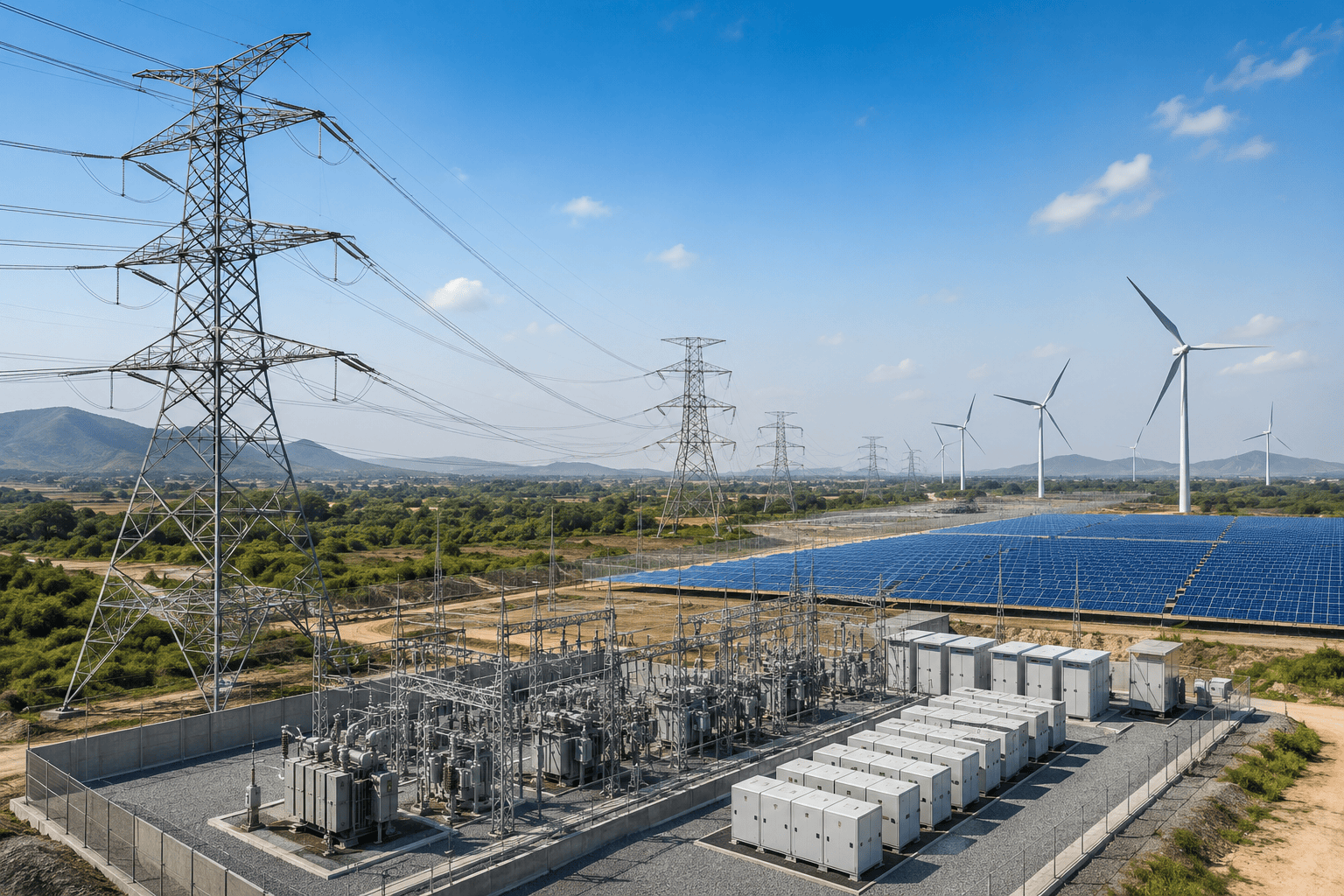
India’s power transmission network now spans over 5 lakh circuit kilometres (Source: Ministry of Power), and the investment pipeline ahead is substantial. The National Electricity Plan envisages the expansion of the national transmission network to about 6.48 lakh circuit kilometres by 2032 (Source: Ministry of Power). The Green Energy Corridors programme sits at the heart of this effort, designed to integrate large-scale renewable capacity into the national grid through dedicated high-voltage transmission infrastructure.
What this scale of ambition tends to obscure is the condition of the domestic execution ecosystem expected to deliver it. The operating environment has changed considerably from earlier phases of transmission build-out. Projects now run within live, heavily loaded systems where outage windows are tightly controlled by grid operators and cannot be treated as flexible. The tolerance for schedule slippage is lower, the coordination demands are higher, and the consequences of missing a commissioning window extend well beyond the project itself into stranded renewable capacity and grid reliability risk.
At the same time, the institutional capacity of the domestic EPC sector has not kept pace with the growth in the order book. The pool of experienced site supervisors has not expanded proportionally. Manufacturing and galvanisation capacity, while growing, still requires careful sequencing. And working capital cycles in transmission EPC remain long, which constrains how aggressively even well-run contractors can mobilise across concurrent projects. These are not new problems, but at the scale India is now pursuing, they carry greater consequences than they did in earlier phases of grid expansion.
Reforms Needed
The most consequential area for reform is the treatment of right-of-way acquisition and statutory clearances. From where I sit in project operations, RoW is consistently the variable that blows up carefully planned schedules. The issue is that the response to it has not been structural. Compensation frameworks vary across states in ways that create genuine uncertainty at the negotiating level. Clearances for lines crossing forest land or state boundaries can extend well beyond the time it takes to complete the engineering and fabrication work. What is needed is a national framework with defined timelines and escalation mechanisms that are enforced rather than aspirational.
Contract structures need to be examined more honestly. The gap between when physical work happens on site and when a contractor can bill for it is a real working capital problem, not a theoretical one. Bank guarantee requirements that do not differentiate between contractors with long track records and those without impose a liquidity burden that is disproportionate to the actual risk being managed. These are areas where developers and financiers can make meaningful changes without increasing their own exposure, and where doing so would improve the quality of execution they ultimately receive.
On the EPC side, the sector needs to invest more consistently in front-end engineering. On the projects where we have taken the time upfront to resolve foundation strategies, access plans, and tower spotting against actual terrain data, execution runs more predictably. Where that work has been compressed in the interest of mobilising quickly, we pay for it later through design revisions, procurement disruption, and schedule recovery that is always more expensive than prevention. This is an internal discipline as much as an external reform, and the industry needs to be honest about it.
Finally, contractors need to be more disciplined about what they bid for. It is easier said than done in a market where the order book matters to investors and lenders, but an EPC business that takes on more work than its supervisory depth and working capital can support ends up delivering poorly on all of it. That is not a good outcome for the sector or for the individual contractor. The companies that emerge from this investment cycle with their reputations intact will be those that chose their projects as carefully as they executed them.
What’s The Problem Areas with Power Producers and How they are Being Addressed
The most acute friction between EPC contractors and power producers tends to cluster around two related problems: who owns the risk of delays that neither party directly controls, and how the financial structure of a project handles those delays when they occur.
Right-of-way disruptions are the clearest example. When a clearance process stalls and a contractor who has already mobilised and committed procurement spend is left absorbing the carrying cost, that is a structural mismatch in how risk is allocated. The contractor has limited ability to resolve the underlying issue but full exposure to its financial consequences.
Progress is happening, though unevenly. Some developers are beginning to treat clearance management as a shared responsibility rather than delegating it entirely to the EPC contractor. Payment structures in certain programmes are becoming more closely tied to measurable progress on site. These are meaningful shifts.
The contractors who are best positioned in this environment are those with strong internal controls over fabrication and logistics, because that reduces their vulnerability when site timelines shift. But operational resilience at the contractor level is not a substitute for better contract architecture at the industry level.

Digital monitoring platforms are also improving visibility for both contractors and developers. Real-time progress tracking across dispersed work fronts helps stakeholders identify slippage early, enabling more timely interventions and more accurate billing milestone projections.
The deeper fix, however, remains contractual and regulatory. Aligning the financial and clearance architecture of large transmission programmes with the realities of infrastructure delivery will determine whether India’s ambitious grid expansion translates into energised assets on schedule.