

Nature-based solutions, several of them validated by breakthrough science published within the last two years, are no longer confined to laboratory settings. They are field-tested, increasingly affordable, and ready for deployment on the ground. What is missing is not the technology. It is the political decision to treat open dumpsites as a climate emergency rather than a municipal housekeeping problem.
Hyderabad’s Jawaharnagar Signal
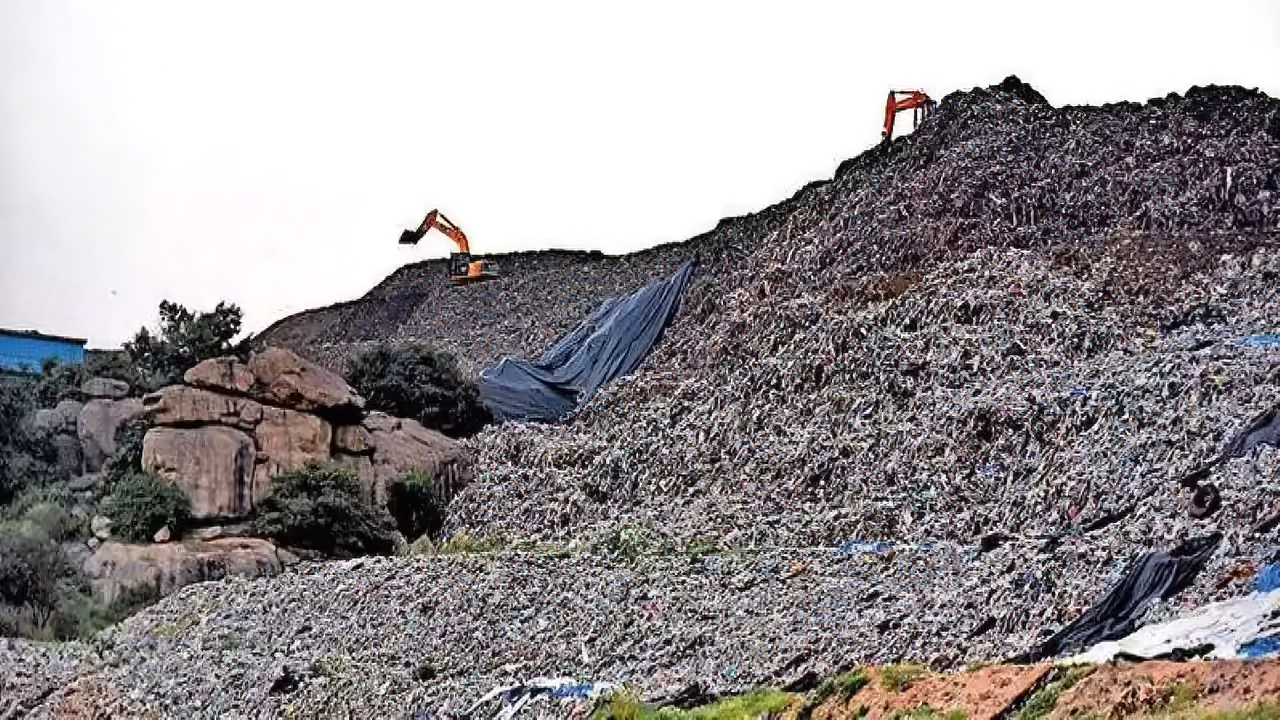
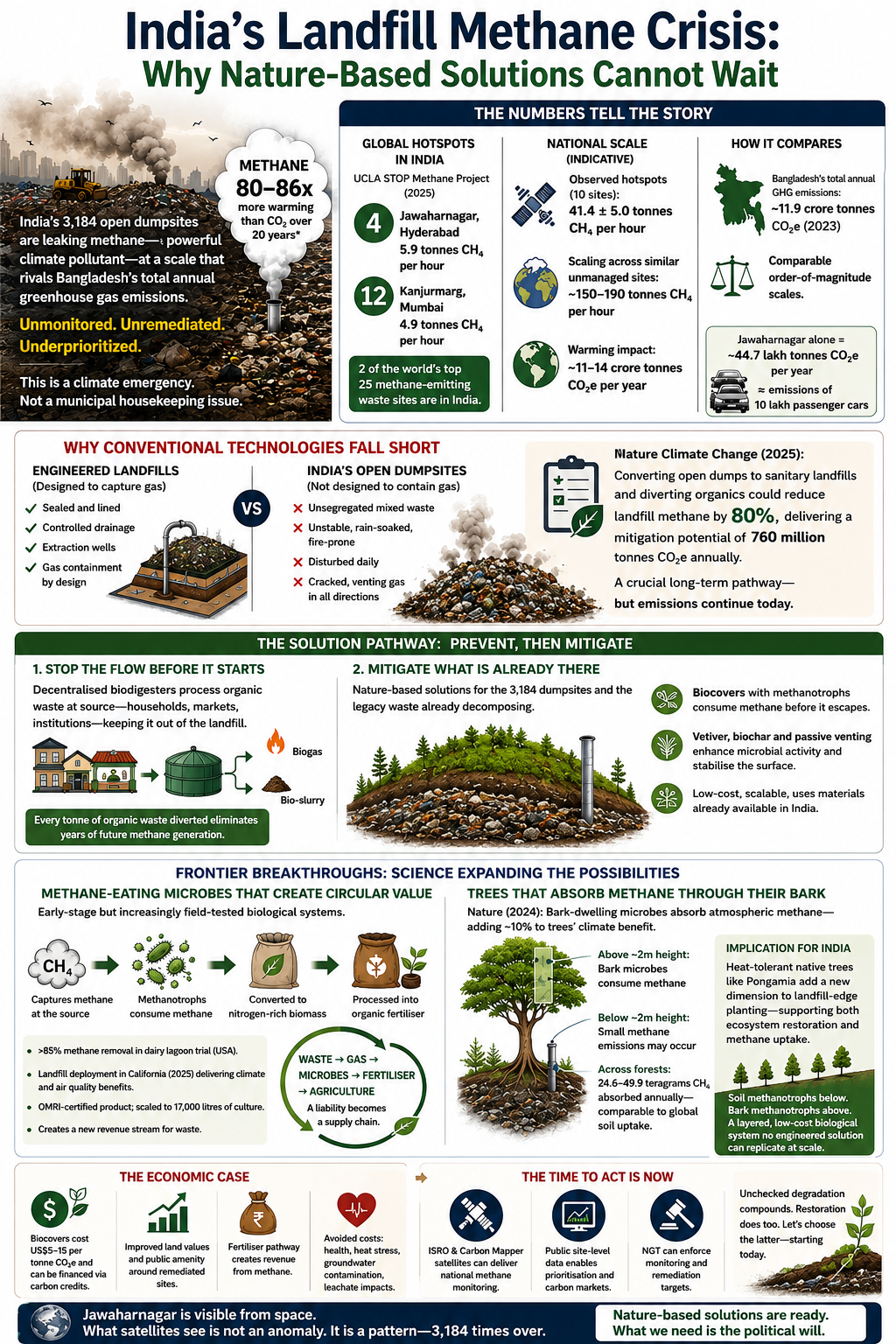
One site makes the national picture tangible. The Jawaharnagar dumpsite near Hyderabad receives approximately 9,600 metric tonnes of municipal waste every day.⁴ UCLA’s STOP Methane Project, using Carbon Mapper satellite instruments that observed the site twenty times in 2025, confirmed an average methane emission rate of 5.9 tonnes per hour — placing Jawaharnagar fourth on the global list of worst-emitting waste sites.²˒³
Methane traps roughly 80–86 times more heat than CO₂ over a twenty-year period,¹ which means this single site produces a warming effect equivalent to approximately 44.7 lakh tonnes of CO₂ annually — roughly the annual emissions of 10 lakh passenger cars.⁵ Jawaharnagar is one site among 3,184.⁶
India also hosts a second landfill in that same global top twenty-five. Kanjurmarg in Mumbai ranks twelfth, emitting an estimated 4.9 tonnes of methane per hour.³ Two of the world’s twenty-five worst methane-emitting waste sites are in India. That is not a coincidence of geography. It reflects decades of underinvestment in waste infrastructure.
Satellite-based research has identified India as having the highest total emissions from observed landfill hotspots — 41.4 ± 5.0 tonnes per hour across just ten sites within the observation field.¹² Extending this observation base across similar unmanaged sites suggests a national-level release on the order of 150–190 tonnes per hour, translating to a warming impact of roughly 11–14 crore tonnes of CO₂ equivalent per year.⁷˒¹² Bangladesh’s total annual greenhouse gas emissions are approximately 11.9 crore tonnes of CO₂ equivalent.⁸ These are comparable order-of-magnitude scales, underscoring the climate significance of landfill methane in India.
Measurement methods vary and estimates will always carry ranges. Satellites capture point-in-time plumes; models carry assumptions; ground measurements remain limited. But the direction of the evidence is consistent. The findings from Jawaharnagar, Kanjurmarg, and broader modelling reinforce each other from different angles.
Why Conventional Technologies Fall Short
India has made genuine efforts on legacy waste. Biomining under Swachh Bharat Mission, National Green Tribunal directions on remediation, waste-to-energy plants in several cities — these are real interventions.¹⁰˒¹¹ But they leave a fundamental gap unaddressed.
Conventional landfill gas capture — the standard approach across Europe and North America — was engineered for sealed, lined sanitary landfills with controlled drainage and dedicated extraction wells. It works because those landfills were designed from the outset to contain and channel gas.
India’s open dumps were designed for no such purpose. They are unstable, rain-soaked, fire-prone accumulations of unsegregated mixed waste, disturbed daily by waste-pickers, cracked by heat, and riddled with subsurface burning pockets from which methane escapes in all directions.
In Telangana, where Jawaharnagar sits, temperatures exceeded 46°C across eighteen districts in May 2024. Farmers collapsed in the fields. Agricultural labourers died on roadsides.¹⁶ Importing gas capture technology designed for a sealed German landfill into this environment is not a scaling challenge. It is a category mismatch.
A landmark 2025 study in Nature Climate Change found that converting open dumpsites globally into sanitary landfills — combined with diverting organic waste to composters and biodigesters — could reduce landfill methane emissions by 80 per cent, delivering a mitigation potential of 760 million tonnes of CO₂ equivalent annually.¹⁷ This reflects a powerful long-term pathway. But it requires extensive infrastructure transition, while emissions continue today.
Decentralised Biodigesters: Stop the Flow Before It Starts
The single most effective intervention occurs before waste ever reaches a dumpsite. Decentralised biodigesters — at the household, market, and institutional level — process organic waste prior to entry into the municipal stream, directly reducing the biodegradable fraction that accumulates in open dumps and generates methane over decades. Kerala and Karnataka have already demonstrated this at scale.¹⁵
Every tonne of kitchen or vegetable waste diverted from a dumpsite eliminates years of future methane generation. Few downstream interventions can match this upstream leverage. Prevention is not the entire solution, but it is the most cost-effective component of it.
Established Nature-Based Solutions for Existing Sites
For the 3,184 sites⁶ already receiving waste — and the accumulated organic mass decomposing within them — biological methane reduction offers practical, low-cost interventions that can be deployed immediately, without waiting for engineered infrastructure.
Biocovers: Putting Methane-Eating Bacteria to Work
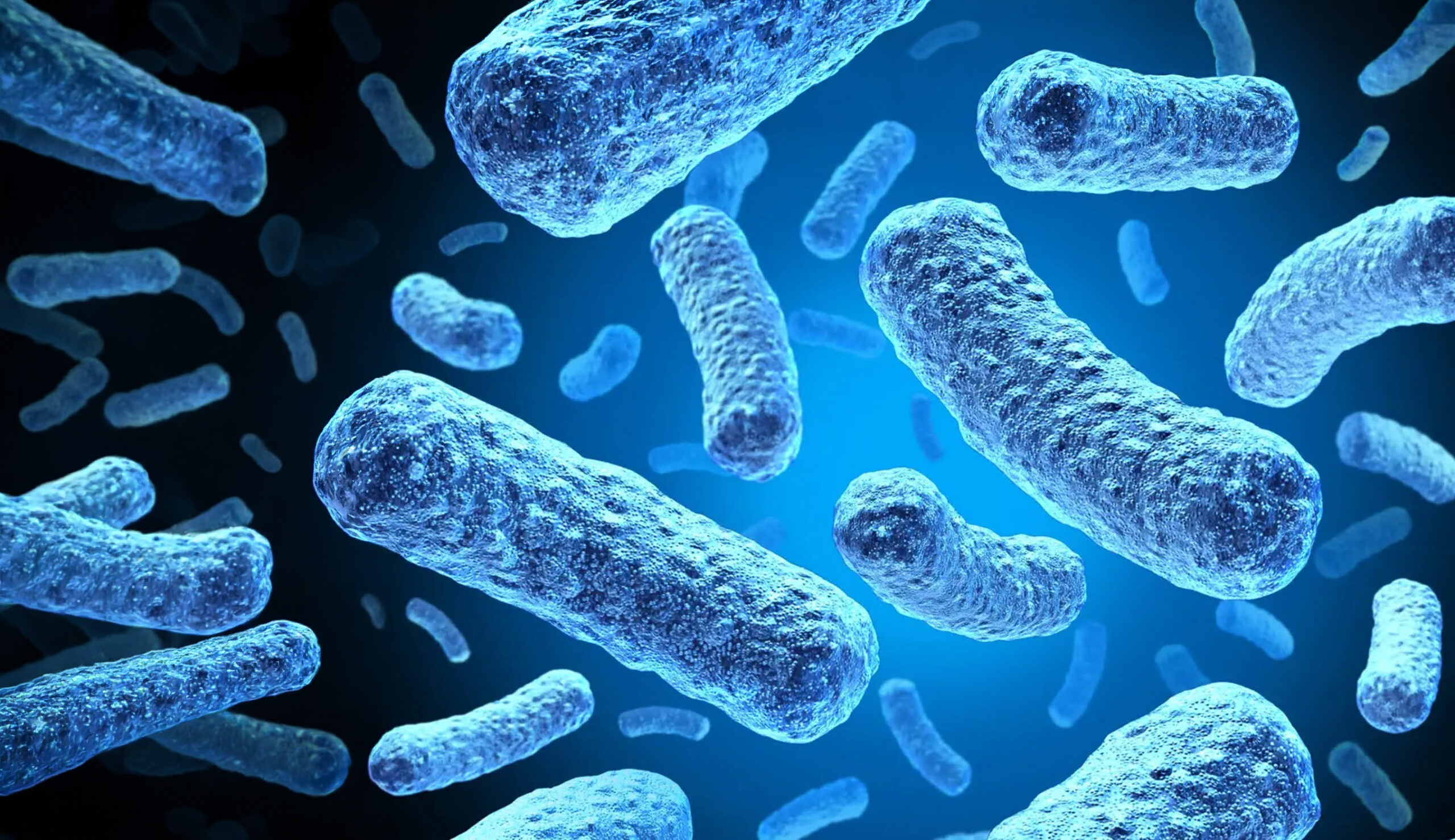
Mature compost placed over waste surfaces supports communities of methanotrophs — methane-oxidising bacteria — that convert methane into CO₂ and water before it escapes into the atmosphere. This conversion significantly reduces warming impact, given methane’s 80-fold higher potency over a twenty-year period.
The Climate and Clean Air Coalition’s assessment of biocover technology finds a methane reduction potential of up to 50 per cent for unmanaged landfills over their lifetime, at a cost of just US$5 to US$15 per tonne of CO₂ equivalent.⁹ That places biocovers among the most cost-effective climate interventions available across sectors.
Researchers at IIT Bhubaneswar have demonstrated that fine material recovered through landfill mining can itself serve as the biocover substrate — meaning the process of excavating and sorting old waste simultaneously generates the material required to control emissions from what remains. It is a closed-loop system, directly replicable at Indian dumpsites.¹⁰ᵃ A bibliometric review of two decades of biocover research published in late 2025 confirms that the field has matured significantly, with biochar-based systems and circular economy integration emerging as leading areas of development.¹²ᵃ
Vetiver, Biochar, and Passive Venting
Vetiver (Chrysopogon zizanioides) — khus, as it is known across India — is a deep-rooted native grass with a long history in soil conservation. It tolerates extreme heat, poor soils, and slope instability without difficulty, making it well suited to conditions at Indian dumpsites. Its dense root systems support microbial activity, resist erosion, and stabilise surfaces that would otherwise crack and vent gas.
Biochar, produced from agricultural residues widely available across India, improves soil porosity and microbial habitat while sequestering carbon. Combined with compost in a biocover layer, it enhances conditions for methanotroph activity. Passive venting systems — perforated pipes that channel gas through compost or biochar layers — allow methane oxidation to occur without pumps or external energy inputs, making them suitable for unstable ground conditions typical of open dumps.
None of these require imported technology. All rely on materials already available within India.
Frontier Breakthroughs: The Science Has Just Got More Interesting
Two developments from the past two years expand the frontier of biological methane mitigation — both with direct implications for India’s dumpsite challenge.
Windfall Bio’s Methane-Eating Microbes
A California-based company, Windfall Bio, has deployed a Siberian strain of methanotroph — Methylotuvimicrobium buryatense — that outperforms other known strains in both consumption rate and adaptability, metabolising methane even at low atmospheric concentrations.¹⁸ In a trial at a dairy farm in northern California, these microbes absorbed more than 85 per cent of methane rising from a manure storage lagoon.¹⁹
In July 2025, the company deployed its microbe-based biocover system at a major landfill in California, applying organisms directly to the surface, where they consumed methane while also removing volatile organic compounds, hydrogen sulphide, and other odorants — delivering air quality benefits alongside climate gains.²⁰
What makes this especially relevant to India’s circular economy ambitions is what happens after methane consumption. Instead of stopping at CO₂, the organisms convert methane into nitrogen-rich biomass that can be processed into certified organic fertiliser.²¹
The company has achieved OMRI certification for its product and scaled microbial production to 17,000 litres of culture.²² Farmers using the fertiliser report costs roughly half those of conventional inputs, according to company-reported outcomes.²¹
In India’s context, this creates a circular loop that reframes the dumpsite entirely. Waste generates gas. Gas feeds microbes. Microbes produce fertiliser for agriculture. A liability becomes a supply chain. This is not yet mainstream infrastructure, but it signals a viable direction for circular waste systems.
Methanotrophs in Tree Bark: A Discovery That Changes the Calculus on Tree Planting
A landmark study published in Nature in July 2024, led by the University of Birmingham, found that microbes living within tree bark absorb atmospheric methane at levels comparable to or exceeding soil — adding roughly 10 per cent to the total climate benefit of trees, a factor not previously included in emissions accounting.²⁴
The researchers found that while trees near the ground may emit small amounts of methane, this reverses at around two metres above ground level: bark methanotrophs begin consuming atmospheric methane, and the effect strengthens higher up the trunk.²⁵
Across tropical, temperate, and boreal forests, trees may collectively absorb between 24.6 and 49.9 teragrams of methane annually — comparable to global soil uptake.²⁶ The effect is strongest in tropical forests, where heat and moisture accelerate microbial activity.²⁷ Parts of peninsular India fall within this climatic range.
For Indian dumpsite policy, the implication reinforces existing recommendations. Pongamia (Millettia pinnata) has long been proposed for landfill-edge planting due to its heat tolerance, nitrogen-fixing capacity, and economic value as a seed oil crop. The Birmingham findings add a previously unrecognised dimension: such trees may also function as methane sinks through bark microbial communities.
Soil methanotrophs in biocovers below. Bark methanotrophs in tree canopies above. Together they form a layered biological system — two independent methane-oxidising pathways — that no engineered system can replicate at comparable cost or ecological depth.
Traditional Knowledge as a Practical Complement
India retains a resource often overlooked in modern planning. Vrikshayurveda — the classical body of plant science documented in texts including Surapala’s treatise¹⁴ — contains long-observed knowledge on plant behaviour in degraded soils, root-zone conditions, and plant-microbe interactions. Collaboration between traditional practitioners and soil microbiologists could help identify locally appropriate species and soil amendment strategies across India’s diverse climatic zones. The value here is practical and applied.
The Economic Case Is Already There
Biocover deployment at US$5–15 per tonne CO₂ equivalent generates carbon credits that can partially or fully finance implementation.⁹ Countries using biocovers at closed landfill sites report rising surrounding land values and improved public amenity — benefits that accrue without additional policy mechanisms.⁹
The Windfall Bio fertiliser pathway adds a potential revenue stream from methane. Meanwhile, avoided costs — public health burdens, urban heat intensification, groundwater contamination from leachate — are significant even where they remain unpriced.
ISRO, working with initiatives such as UCLA’s Carbon Mapper Project, is well positioned to establish a national landfill methane monitoring system. Public site-level emissions data would prioritise remediation and enable carbon market participation. The National Green Tribunal can further strengthen methane monitoring requirements and enforce remediation targets.
The Cost of Waiting
Detailed modelling of landfill methane’s cascading impacts — urban heat island effects, agricultural productivity loss in surrounding districts, groundwater contamination from leachate migration — is important work and should continue. But it should proceed in parallel with action, not as a precondition for it.
The extreme temperatures that killed farmers in Telangana in May 2024 were not model outputs. They were observed conditions reported across the region. Jawaharnagar sits within one of South Asia’s most densely populated metropolitan corridors, emitting methane at rates confirmed by satellite instruments. The case for action is already sufficiently clear for policy intervention.
There is a principle in Ayurvedic thought — samāna vriddhayante, like increases like — that has a useful ecological parallel. Unchecked biological degradation compounds over time. But so does restoration. Biocovers build microbial communities that strengthen over years. Trees begin methane uptake within a growing season and continue for decades. Biodigesters reshape waste streams permanently. What appears incremental does not remain so.
Jawaharnagar is visible from space. What satellites are measuring is not an anomaly. It is a repeating pattern — 3,184 times over.⁶
References
- IPCC, Sixth Assessment Report, 2021.
- UCLA Emmett Institute, STOP Methane Project, April 2025.
- Carbon Mapper / UCLA site data, 2025.
- GHMC waste data.
- Down To Earth, landfill methane benchmarks, 2023.
- CPCB / MoHUA landfill inventory.
- Mor et al., Frontiers in Sustainable Cities, 2024.
- EDGAR / World Bank emissions datasets, 2023.
- Climate and Clean Air Coalition, 2024.
- Swachh Bharat Mission Urban reports.
- National Green Tribunal orders (2019–2023). 10a. IIT Bhubaneswar study via Down To Earth, 2024.
- Nature satellite methane study, 2025. 12a. Springer biocover review, 2025.
N/A- Surapala’s Vrikshayurveda translation.
- Kerala & Karnataka SWM pilots.
- Telangana heatwave reports, 2024.
- Nature Climate Change, 2025 methane mitigation study.
- Washington Post methane microbes feature, 2025.
- Windfall Bio dairy trial reports, 2025.
- GlobeNewswire landfill deployment, 2025.
- AgFunder News / AgTech reporting, 2025.
- Agriculture Dive / OMRI certification reports, 2025.
- Nature, tree bark methane uptake study, 2024.
- University of Birmingham press release, 2024.
- CREAF methane uptake synthesis, 2024.
- UK Centre for Ecology and Hydrology, 2024.

Ram Ramprasad writes on sustainable development, governance, and ecological systems. He is an economics graduate of Yale University.
Ram’s previous articles published in SustainabilityNext
Rivers Revive When Someone Owns the Outcome
Ecological Ayurveda: Reimagining the Circular Economy
Activating the World’s Dormant Climate Solutions
India’s LPG Crisis: A Three-Pillar Path to Resilient Cooking
How Mycelium Can Power a Green Startup Revolution
Microbes Can Drive India’s Sustainable Future
Rethinking India’s Sustainable AI Policy
Minimize Beef and Dairy Consumption
From Ātma Nirbhar to Ātma Bhūmi Nirbhar: India’s Civilizational Path to True Self-Reliance
Why India Needs a Millet Revolution
Common Sense Strategies to Reduce Methane Emissions from Cattle
Integrated Offshore Water and Wind Solution for India’s Coastal Cities
Gut and Soil Microbial SustainAbility Bridges Science and Ancient Indian Wisdom
From Waste to Wealth: Rebranding Sewage Treatment Plants (STPs) to Resource Recovery Plants (RRPs)
The Hidden Crisis with Our Beds
Startup ideas for Sustainable Cremation and Burial Solutions in India
How India’s Agriculture Can Save 200 Billion Cubic Meters of Water
Ten Powerful Reasons for Declaring Moon A Living Entity
Sustainable Wind Turbines: Balancing Bird Protection and Agriculture
A Holistic Water Strategy for India
How India Can Leverage its GST Model for Building a Sustainable Future
A Toolkit for India’s Green Transition
Green Building Strategy – Integrating Innovations from East and West
Eat Less Fish, Save the Planet
Startups are Working Hard for a Plastic-free World
Hydrogen More Harmful Than Fossil Fuels
Tech Startups Can Make India Water Rich
Measure How Basic Elements are Doing, Not Just GDP
A Radical Strategy for A Greener India – The Story of Kusha







[…] India’s Landfill Methane Crisis: The Power of Nature-Based Solutions […]
[…] India’s Landfill Methane Crisis: The Power of Nature-Based Solutions […]