

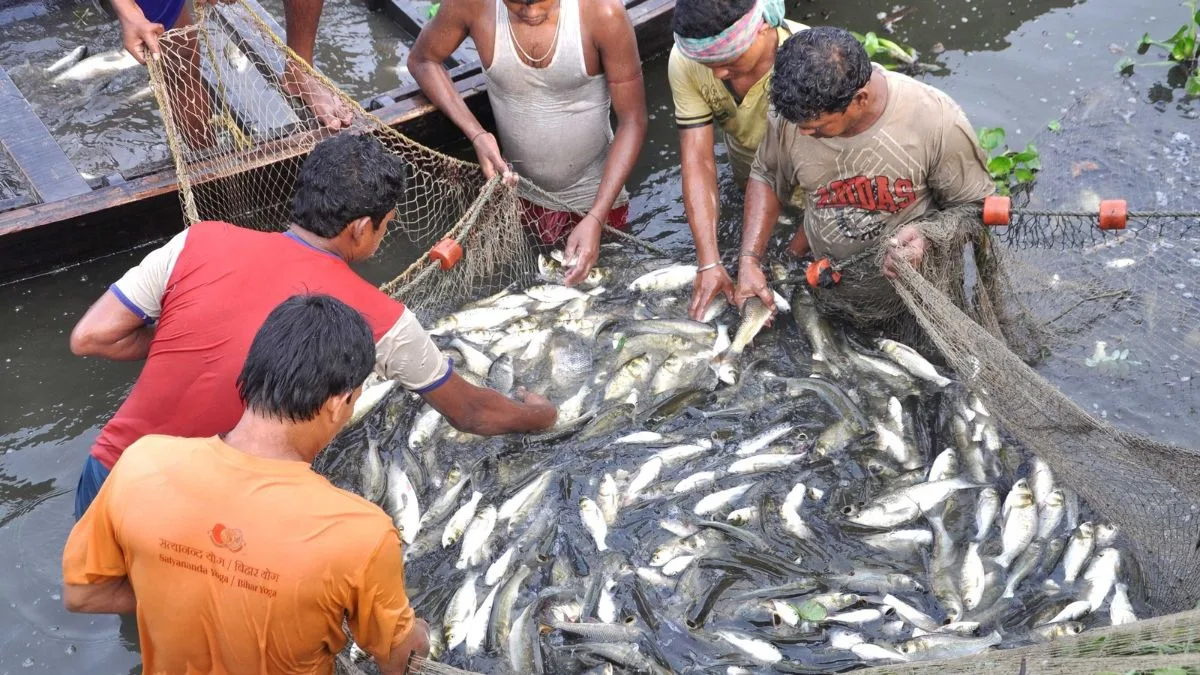
Somewhere off the Chennai Coast, a fisherman hauls in a net before dawn. By evening, his catch has passed through a landing centre, an auction shed, a cold-storage unit, and a processing plant. By the following week, it may be on a dinner table in Doha or Dubai. Yet at almost every point in that journey, the record of where this fish came from, how it was caught, and whether it was legally harvested exists only as a handwritten entry in a ledger, or not at all.
This invisibility is India’s most consequential fisheries problem. And the consequences are no longer abstract.
India is now one of the world’s largest seafood producers. The marine fisheries sector supports nearly 30 million livelihoods and contributes about one per cent to national GVA. Seafood exports crossed Rs 65,000 crore in value in recent years, with shrimp alone accounting for nearly 40 per cent of total marine export volume.
Fish production has more than doubled over the last decade. The systems governing this trade, however, have not grown with it. Qatar’s temporary ban on Indian frozen seafood and China’s earlier suspension of shipments from several Indian seafood-processing units showed how quickly market access can be disrupted when importing countries raise food-safety, documentation or source-control concerns. These were not isolated incidents. They were market verdicts on a supply chain that cannot account for itself.
In an era when the European Union’s import control regulations, the United States Seafood Import Monitoring Program, and the Marine Stewardship Council’s Chain of Custody standard are reshaping global trade, traceability has stopped being optional. It is the entry ticket.
But here is the important distinction: if traceability were purely a technology problem, India would have resolved it already. A country that built UPI at extraordinary scale is not short of digital capability or implementation muscle. The challenge in fisheries is not technological. It is behavioural, institutional, and political. The real test is not building the tool. It is persuading the fisherman to trust it.
This is not to say the technology is irrelevant. QR codes, RFID tags, vessel monitoring systems, electronic catch documentation and IoT-enabled cold-chain sensors can create end-to-end visibility from net to plate. A consumer in Frankfurt could, in principle, scan a packet of Indian prawns and verify when and where it was caught, whether it met sustainability standards, and whether it passed food-safety checks at every stage. That level of transparency changes incentives across the entire system: exporters gain credibility, regulators gain oversight, scientists gain reliable data, and responsible fishers gain recognition.
The problem is that technology arrives at the shoreline and stops.
India has, to its credit, begun responding with intent. The 2025 “National Framework on Traceability in Fisheries and Aquaculture” marks the first time India has attempted a unified governance architecture connecting fishers, vessels, landing centres, processors and exporters through shared digital infrastructure.
The Pradhan Mantri Matsya Kisan Samridhi Sah-Yojana, a sub-scheme under the larger PM Matsya Sampada Yojana, places traceability at its operational centre, channeling investment specifically toward formalising fishers and building supply-chain documentation capacity. These are meaningful commitments. The question is whether a fisher in Rameswaram will ever see a reason to use it.
Fish Meal and Fish Oil
Critically, fish meal and fish oil, which together represent a substantial and growing segment of marine production, remain almost entirely outside traceability frameworks. India is among the top producers of fish meal globally, supplying aquaculture feed both domestically and for export.
Yet the species composition, sourcing zones and catch documentation for reduction fisheries, where fish are processed directly into meal and oil rather than sold for human consumption, are poorly monitored. This gap is ecologically significant because reduction fisheries can mask overfishing of small pelagic species that are foundational to marine food webs. Including fish meal and fish oil within the national traceability framework is not peripheral. It is essential.
This is where the Marine Products Export Development Authority’s role must expand significantly. MPEDA registers exporters, monitors residue levels, facilitates certification and maintains India’s position in compliance-driven markets. It has piloted traceability initiatives for shrimp and is increasingly engaging with digital documentation.
But MPEDA’s reach must now extend deeper into the domestic supply chain, working with landing centres and cooperatives to build the documentation infrastructure that export compliance ultimately depends upon. An exporter cannot certify what a landing centre has not recorded.
The most durable traceability models globally have worked through cooperatives rather than compliance mandates imposed on individuals. Fish Farmer Producer Organisations and fisher cooperatives can serve as aggregation nodes, recording catches collectively, in regional languages, through offline-compatible systems that synchronise when connectivity is available. Financial incentives for verified traceable catch can make participation economically rational rather than merely regulatory.
The institutional challenge is equally pressing. The Department of Fisheries, CMFRI, FSSAI, MPEDA, coastal States and regional bodies each hold part of the answer, but they still operate too often in parallel. State-level Marine Fishing Regulation Acts (MFRAs) must also be amended to recognise electronic documentation and create penalties for unreported catch. As long as traceability remains only an export-compliance mechanism, it will never transform domestic fisheries governance. None of this can happen in isolation, and none of it will happen through policy documents alone. What is needed is a shared understanding that the ocean’s future and India’s fisheries economy are not separate concerns.
This year’s World Oceans Day theme, “Reimagine: Beyond the World We Know, A New Relationship with Our Ocean,” asks for something harder than awareness. It asks for structural transformation. For India, that means accepting that the ocean economy cannot be measured only in export volumes. It must also be measured in the health of fish stocks, the security of coastal livelihoods, and the integrity of the supply chains that connect both.
Every fish entering a global market should carry a transparent story of legality, sustainability and fairness. Every fisher contributing to that market should be visible within governance systems, not relegated to its margins. The ocean does not need another year of declarations. It needs the systems, social, institutional and digital, to finally make that story legible.

Vijai Dharmamony
Senior Manager, Climate Resilient Fisheries,
Environmental Defense India Foundation

Nidhi Agarwal
Environmental Defense India Foundation