

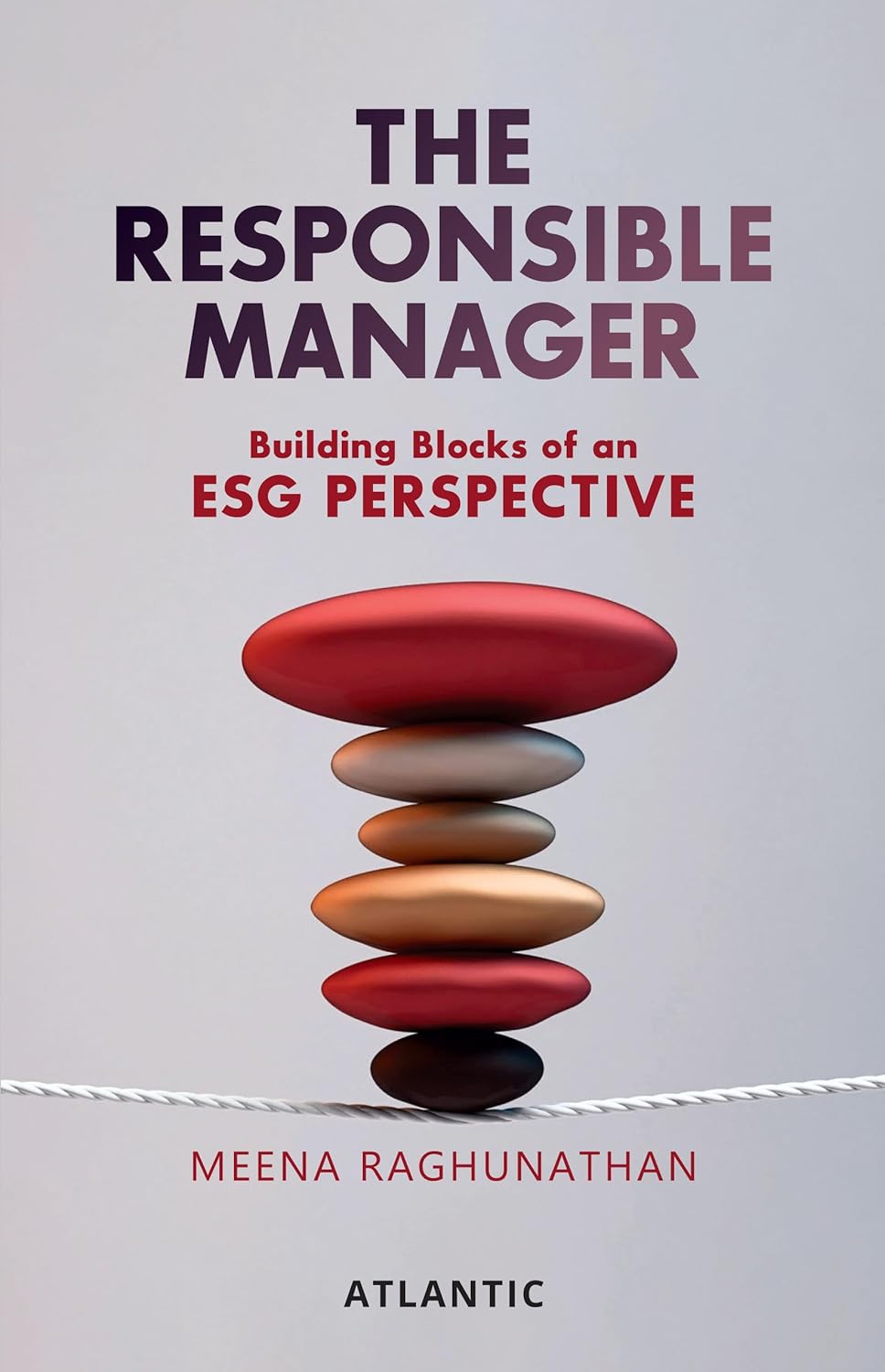
Meena Raghunathan’s book, “The Responsible Manager,” is an exceptional guide for anyone looking to demystify this space. The author dives deep into the breadth of topics falling under the Environment, Social, and Governance pillars, providing both essential historical context and a clear picture of the current regulatory and non-regulatory landscape.
For instance, Corporate Social Responsibility (CSR) is masterfully broken down—delving into its history, its critics, the evolution of current legislation, and the operational details of how CSR laws can be implemented within organizations. By anchoring these concepts with real-life examples, Raghunathan makes complex ideas highly accessible.
Furthermore, while the ‘E’ and ‘S’ pillars may be reasonably familiar to mid-level ESG practitioners, Corporate Governance is often less understood. The author brilliantly demystifies Governance, breaking down vital topics such as board committees, independent directors, board diversity, and board evaluations, mapping out exactly where the Board’s responsibilities lie regarding ESG.
Having given advanced praise for The Responsible Manager, I stand firmly by my endorsement of this book as a premier guide for anyone completely new to ESG. It does a phenomenal job of breaking down the fundamental pillars of Environment, Social and Governance into clear, accessible concepts, making it an ideal candidate to serve as a textbook for colleges and universities offering courses in sustainability.
Oversimplifies Real World Challenges
However, from the perspective of a practitioner examining the broader corporate sustainability landscape, it is important to set realistic expectations about the book’s limits. The book’s strength lies in the depth of its coverage. Having said that, this level of detail can also make it challenging to navigate. My review centers around 2 aspects:
- Lost in the Details: The book’s greatest strength—its sheer depth—is also its primary challenge. In trying to provide a comprehensive array of details and scenarios, the narrative occasionally gets lost in the weeds. This makes it difficult for readers to easily separate core, actionable arguments from supporting background information.
- Tactical Execution vs. Strategic Checklists: Because it is nearly impossible to cover every possible implementation scenario, the book occasionally oversimplifies real-world execution and implementation challenges. By attempting to checklist every potential path, it misses the tactical, day-to-day nitty-gritties and the inevitable hurdles of managing organizational change.

Readers looking for a step-by-step, tactical manual on how to realistically translate ESG concepts into daily business operations will find that this book serves as a perfect launching pad— but one that will ultimately require further resources for actual execution.