

a
Highlights
- The green credit program should be available for all farmers, not only for plantations
- Tree plantation projects can extend beyond forests so that farmers can benefit too
- To ensure co-benefits don’t sideline carbon offset projects altogether
- India should promote international carbon trade under Article 6 of the Paris Agreement, this would open a new channel for climate finance
- India is not promoting nature based solutions aggressively.
- India needs an integrated environmental markets, not silos
- India should trust voluntary private disclosures more
a
The Indian Carbon Market (ICM) is currently in its developing phase with promising potential for the future impacts. Compliance and voluntary carbon markets have across the world pumped billions of dollars for the cause of climate change adaptation and mitigation. India must set inspirational standards in terms of nationally determined contributions (NDC) to lead the path of decarbonization.
This makes it imperative to have a thriving domestic carbon market that can channelize funds to green projects and sectors that can not only help reduce emissions but also result in co-benefits that revolve around livelihood and empowerment.
After having experience with Perform Achieve and Trade (PAT), Renewable Energy Certificates (REC), Extended Producer Responsibility (EPR), and Surat Clean Air Market, India launched its own carbon credit trading scheme (CCTS) in 2023 to facilitate the development of domestic carbon market in the country. The government also launched a green credit program (GCP) which does not focus on ‘emissions’ per se but promotes afforestation and other activities in line with Mission LiFE.
India must take lead in developing and adopting carbon capture methodologies which are currently being developed by the international organizations. This would ensure reduction in emissions along with reducing atmospheric carbon which would lead to targeted action towards goals enshrined in the Paris Agreement.
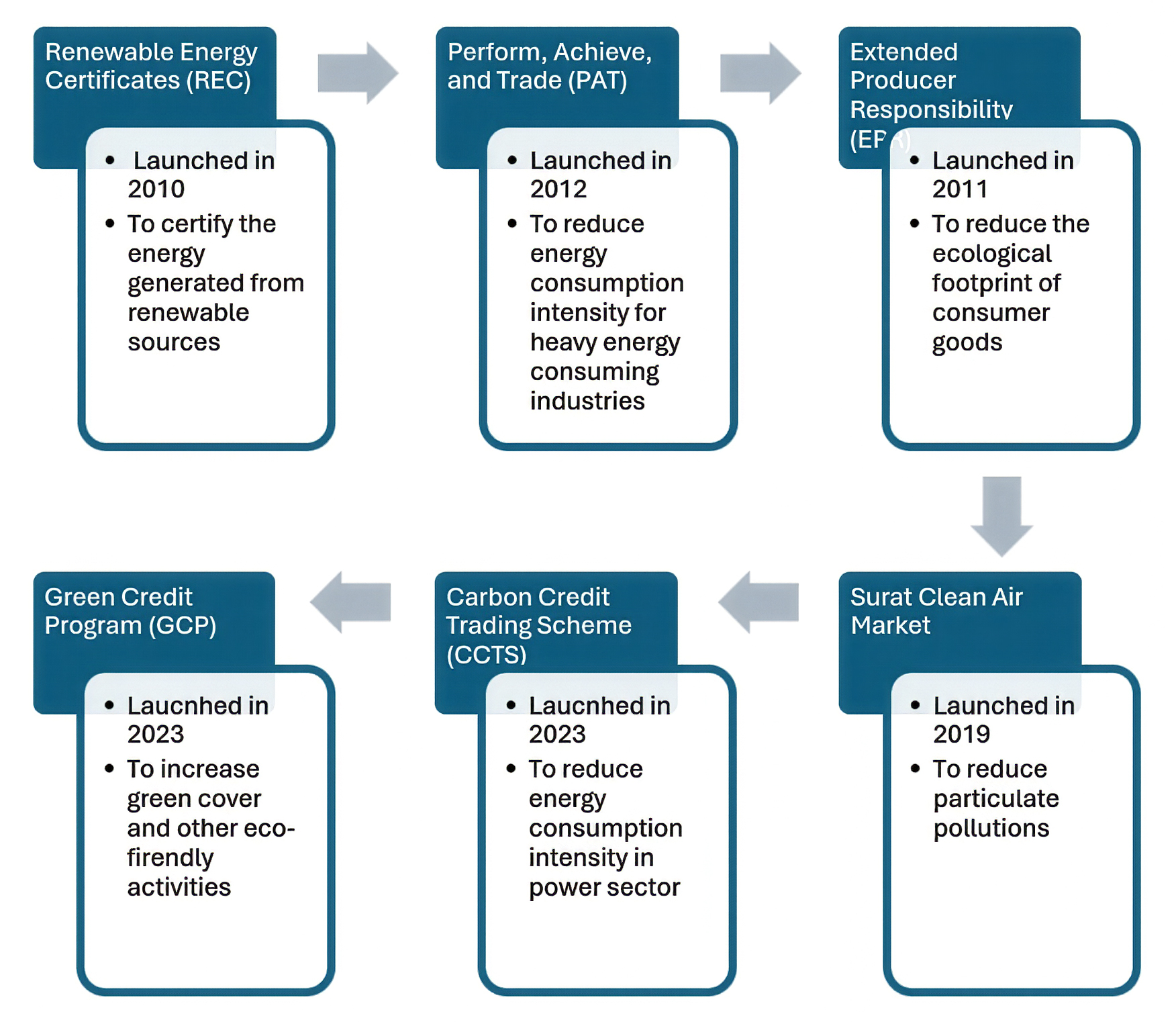
The green credit program (GCP) attempts to incentivize tree plantation, water management, sustainable agriculture, waste management, air pollution reduction, mangrove conservation and restoration, ecomark label development, and sustainable building and infrastructure. However, the methodology or the standard operating procedures (SOP) are notified for the tree plantation projects only. If the detailed procedures for other designated sectors could be notified, GCP could prove to be a gamechanger policy for the environmental domain as it goes beyond the ‘emissions’ and adopts an ecosystemic approach.
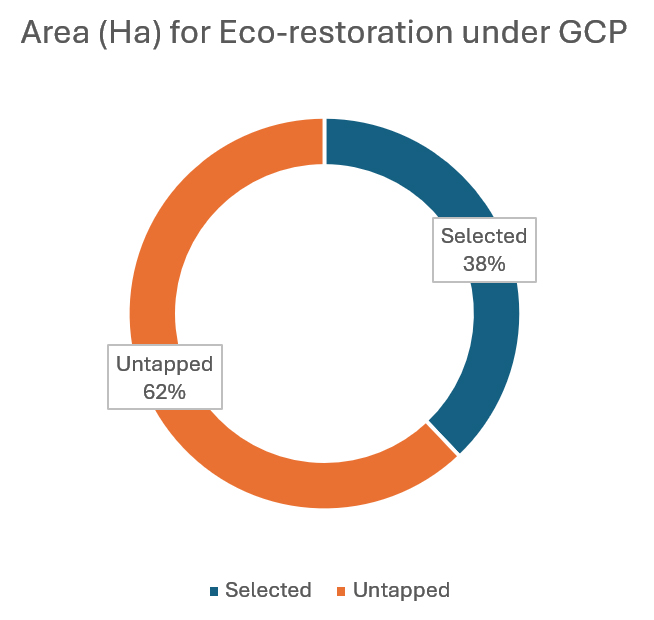
Moreover, the project proponent in tree plantations could be one of the forest departments in the country only. This way, so far about 7,761.67 hectares (~38%) of land has been selected for eco-restoration out of 20,463.17 hectares being available for it. But this excludes the farmers who could have availed the benefits of climate finances and adopted agroforestry practices leading to co-benefits. By involving farmers, we can increase the green cover of trees outside forest (TOF).
The mangrove conservation and restoration is covered by the CCTS as well, which raises concerns of double counting or double claiming. Most international carbon registries do not allow double counting or double claiming of carbon credits as it goes against the integrity principle of the carbon markets. Though GCP is voluntary, its proceeds could be leveraged for compensatory afforestation, corporate social responsibility, and other mandates.
The government has released a detailed procedure for compliance mechanism under CCTS, which covers operational specificities of the compliance-based Indian carbon market (ICM). However, the Indian carbon market (ICM) is disproportionately skewed towards compliance. The voluntary carbon markets (VCM) have been doubted for their credibility in monitoring, reporting, and verification (MRV) since EU ETS had banned offset credits.
However, offsetting mechanisms promise co-benefits which have larger impact as far as sustainable development goals (SDG) are concerned. Moreover, the offsetting mechanisms channelize funds towards livelihood generation, financial inclusion, and wellbeing which lead to empowerment of the marginalized population. Whereas the compliance mechanisms lead to money ending with the government or the corporations. Therefore, it is of utmost importance to formulate policy measures to ensure credible monitoring, reporting, & verification (MRV) and authentic auditing of the offsetting carbon projects, which result in co-benefits. Light-but-tight regulatory approaches should be pursued instead of sidelining the offsetting carbon projects altogether.
| Dimension | Compliance Carbon Market | Voluntary Carbon Market |
| Purpose / Outcome Focus | Govt/corporate-focused outcomes | Strong co-benefits, SDG impact |
| Financial Flow | Funds stay with govt/corporations | Funds benefit communities & developers |
| MRV Credibility | Structured procedures; stronger regulation | Weak MRV; credibility questioned |
| Regulatory Approach | High regulation | Light-but-tight regulation needed |
| Co-benefits | Limited | Strong livelihood, empowerment focus |
The government has released detailed procedure for offset mechanism under CCTS as well to regulate the offsetting carbon projects. Several methodologies and sectors have been approved for offsetting carbon projects giving a fillip to the voluntary carbon market (VCS) in India. However, these methodologies and sectors are limited in their scope and need to be increased which will boost climate action along with co-benefits. Since, the offsetting methodologies under CCTS mostly refer to the United Nations Framework Convention on Climate Change (UNFCCC) Clean Development Mechanism (CDM) methodologies, they can incorporate more such methodologies from other registries as well, viz. Gold Standard, Verra, Puro.earth, and Isometric.
Novel promising nature-based solutions (NbS) and technically sophisticated carbon removal techniques like enhanced rock weathering, direct air capture, direct ocean capture & storage, mineralization, alternate wetting and drying, biochar, etc. could be scaled up for offsetting carbon. Government’s support and incentives could promote research and development (R&D) in such technologies resulting in development of robust MRV mechanisms and platforms. Project proponents may also gain confidence in launching such projects which otherwise do not take off due to financial constraints.

India possesses significant advantages to leverage its capacity for nature-based solutions (NbS) to contribute to the global cause of climate change adaptation and mitigation. Under Article 6 of the Paris Agreement, carbon markets reach beyond borders to enable international trade of carbon credits. This is primarily achieved via private project developers who invest in carbon sequestration and removal projects, earn credits, and sell them to the international buyers via voluntary or compliance procedures.
India has plenty of carbon projects registered under the international carbon registries with issued and retired carbon credits. If the government forges partnerships with other countries to take part in international carbon trade under Article 6 of Paris Agreement, this would open a new channel for climate finance while satisfying the nationally determined contributions (NDC) criteria. India can potentially be the seller and earn carbon credits from the buyers hailing from the global north.
Since the Godavarman case banned timber harvesting even on private forest land without permits, the incentives to grow trees suffered a blow. Now, the climate action and the market-based instruments related to it provide a promising reason to grow them again. However, we need to think beyond the emissions, plastics, and pollution.
Nature-based solutions (NbS) and ecosystems-based adaptations (EbA) that result from systems thinking need to be pursued. This calls for integrated environmental markets which consist of interoperable mechanisms that help the carbon projects with co-benefits scale up and drive the marginalized sections to the forefront to lead climate action through climate finance. This would require serious improvements in the current scheme of things which are compromised by complex procedures and red tape.