

The Real Constraint Is Not Technology—It Is Thinking
Before we activate dormant patents, we must also activate dormant ways of thinking.
The climate crisis is not waiting for new inventions. If anything, it is waiting for better decisions.
India’s idea of Atma Nirbhar—self-reliance—must now evolve. In a world defined by ecological stress, supply disruptions, and growing dependence, self-reliance cannot remain purely economic. It has to become ecological as well.
Self-reliance must evolve into Atma Bhumi Nirbhar—a model rooted in the health of:
Soil, Water, Air, Energy systems (fire), Space. This shift is not philosophical—it is practical in very real terms. It moves us:
- From linear extraction → circular regeneration
- From fragmented solutions → system-level thinking
- Toward long-term resilience instead of short-term output
When we begin to think through the lens of the five elements, innovation starts to align with nature—not against it.
But this shift must go further. It must translate into strategy.
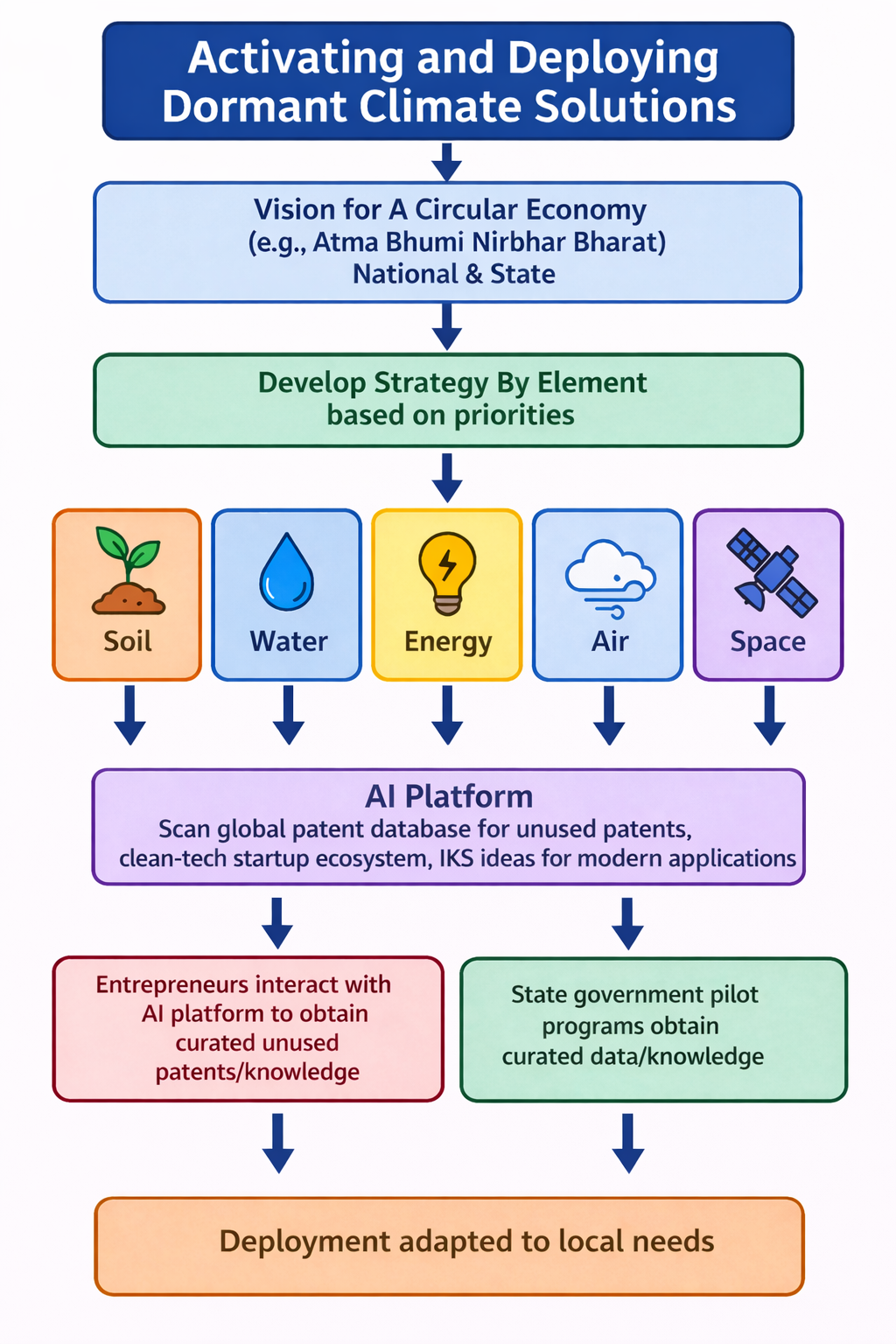
Each element—soil, water, energy (fire), air, and space—needs a clear, outcome-driven innovation and deployment roadmap aligned with Atma Bhumi Nirbhar.
Without element-wise strategies, ecological thinking remains abstract. With them, it becomes actionable.
Without this shift, even the best technologies risk remaining unused—or worse, misused.
The World Is Producing Solutions at Scale
Every year, hundreds of thousands of patents are filed globally, including a rapidly growing share in climate-relevant technologies. According to the World Intellectual Property Organization (WIPO), millions of patents are filed annually across countries, creating a vast and continuously expanding repository of innovation.
This includes: Clean energy, Water systems, Sustainable agriculture, Environmental protection
This is not a shortage of ideas. It is an abundance. And yet, much of it never reaches the ground.
The 70% Problem: Innovation Without Use
It is widely estimated—though the exact number varies—that a large share, often cited around 70%, of patented technologies globally never reach meaningful commercial deployment or widespread use. This is the uncomfortable truth:
- Technologies exist—but remain in labs
- Pilots often succeed, yet don’t scale
- Many solutions are known, but never matched to real needs
We are not facing an innovation gap. We are facing a deployment gap. In a climate-constrained world, that gap is no longer easy to justify.
Dormant Innovation Is Hiding in Plain Sight
The evidence is widespread—and, in many cases, surprisingly visible:
- India captures only a small share of landfill methane, while countries like China treat landfills as engineered energy systems
- Studies suggest that a significant portion of landfill methane can be captured and utilized cost-effectively using existing technologies
- Atmospheric water generation technologies can produce freshwater with lower ecological impact than large-scale desalination, yet remain under-deployed
- Blue energy systems—harnessing energy from the ionic differences between freshwater and seawater before they mix—are ecologically less disruptive than dams
- Painting one wind turbine blade black can significantly reduce bird mortality, yet adoption remains inconsistent
- Urban micro-wind systems for low wind speeds exist for decentralized generation but are rarely integrated into city design frameworks
- Early-stage AI platforms, including those exploring Indian knowledge systems for modern applications, are beginning to emerge but remain underutilized
Microbial systems, in particular, remain among the most powerful but underutilized tools in climate innovation. They can:
- Regenerate soils
- Enable new ways to produce dairy, food, and biomaterials—freeing vast tracts of land
- Purify water
- Enable decentralized energy pathways
- Improve air quality
These are not obscure technologies. They are proven—but under-deployed solutions. The real gap is not invention—it is integration.
More on the topic: https://sustainabilitynext.in/microbes-can-drive-indias-sustainable-future/
Why the System Fails
The breakdown typically happens between invention and scale:
- Weak commercialization pathways
- Fragmented regulatory systems
- Limited early-stage risk capital
- Poor coordination between innovators and users
Even when technologies are ready, markets tend to resist them. Existing supply chains, infrastructure, and procurement systems favor the familiar—sometimes more than they should. This creates a double barrier:
- Innovation struggles to scale
- Markets struggle to absorb change
India’s own policy architecture reflects this gap. Despite having one of the world’s most sophisticated indirect tax systems, the GST framework has not been fully leveraged to drive a circular economy. Environmentally beneficial and regenerative products are not consistently placed in the lowest tax tiers—missing a powerful opportunity to shape demand and accelerate adoption. Policy exists. Alignment does not.
AI as the Missing System Layer
The scale of unused innovation is too large for manual navigation. Artificial intelligence can change this—not as a buzzword, but as infrastructure. AI can:
- Scan global patent databases
- Identify high-potential but underutilized technologies
- Match them with local ecological and economic needs
- Integrate insights from startup ecosystems
- Incorporate emerging frameworks, including those based on Indian knowledge systems
It can begin to transform a fragmented global knowledge base into a usable system of action. The question is no longer whether solutions exist. The question is: Which ones should we deploy—here, now, at scale?
China’s Shift: Pressure, Policy, and Enforcement
China’s move toward building an “ecological civilization” was not driven by idealism alone. It was also a response to:
- Severe environmental degradation
- Rising public unrest over pollution
- Declining quality of life
The response was structural. China enshrined this goal into its Constitution in 2018, signaling long-term national commitment. More importantly—it enforced it. Policies are implemented and monitored at provincial and local levels, helping ensure that national intent translates into ground-level action. At the same time, China has emerged as a global leader in green patent filings. The pattern is clear:
- When ecological priorities are embedded in governance
- And backed by enforcement
→ Innovation and deployment accelerate
India must ask: Why not us?
India’s Moment: From Innovation to Activation
India does not lack talent, entrepreneurship, or technological capability. What it lacks is a clear, sustained mission to activate what already exists. This is not about launching entirely new programs. It is about focus, coordination, and urgency. A national effort must center on three actions:
1. Discovery
- Create a two-way system where entrepreneurs can query a national or sectoral coordination body
- Provide curated, actionable insights on relevant global technologies
2. Adaptation
- Localize solutions for India’s ecological, economic, and social contexts
3. Deployment
Scale through:
- Startups
- State-level pilots
- Public procurement
- Private investment
- International collaboration
The foundation already exists. What is missing is alignment.
Entrepreneurs do not lack ideas. They often lack visibility into the world’s existing climate solutions.
Many Pathways, One Direction
Deployment will not follow a single path. It will likely emerge through multiple channels:
- Startups adapting technologies locally
- State governments piloting solutions
- Procurement systems creating early demand
- Licensing, financing, and targeted foreign investment
Flexibility is essential. But direction must be clear.
Reinvention Is Now a Liability
In an earlier era, reinventing solutions was often necessary. Today, it is increasingly inefficient. We live in a world of:
- Climate urgency
- Supply chain fragility
- Constrained resources
Time is limited. Reinventing what already exists is no longer innovation in many cases. It is delay. The shift is clear:
- From invention → activation
- From creation → deployment
From Possibility to Execution
A clear ecological vision aligned with national priorities—structured through the five elements of soil, water, air, energy, and space—is essential to move from intent to coordinated execution. Many solutions already exist in plain sight, waiting to be deployed rather than neglected. Progress in other economies shows that ecological transformation is achievable through disciplined implementation, while India must chart its own context-specific path. At the same time, the window for action is narrowing.
Focusing on new extractive frontiers while proven, underutilized solutions remain idle represents a fundamental mismatch of capital, time, and ecological risk. It is not expansion—it is inefficiency at scale. The opportunity lies in activating and scaling what already exists—building a system of sustainable development defined not by reinvention, but by: Efficiency, Speed, Scale, Wisdom.
Where reinvention gives way to intelligent activation at speed.

Ram Ramprasad is a sustainability thought leader and author who writes on climate innovation, water systems, and ecological economics. A graduate of Yale University in economics, he has published widely in platforms such as Sustainability Next and TerraGreen, focusing on practical pathways for sustainable development.
Ram’s previous articles published in SustainabilityNext
India’s LPG Crisis: A Three-Pillar Path to Resilient Cooking
How Mycelium Can Power a Green Startup Revolution
Microbes Can Drive India’s Sustainable Future
Rethinking India’s Sustainable AI Policy
Minimize Beef and Dairy Consumption
From Ātma Nirbhar to Ātma Bhūmi Nirbhar: India’s Civilizational Path to True Self-Reliance
Why India Needs a Millet Revolution
Common Sense Strategies to Reduce Methane Emissions from Cattle
Integrated Offshore Water and Wind Solution for India’s Coastal Cities
Gut and Soil Microbial SustainAbility Bridges Science and Ancient Indian Wisdom
From Waste to Wealth: Rebranding Sewage Treatment Plants (STPs) to Resource Recovery Plants (RRPs)
The Hidden Crisis with Our Beds
Startup ideas for Sustainable Cremation and Burial Solutions in India
How India’s Agriculture Can Save 200 Billion Cubic Meters of Water
Ten Powerful Reasons for Declaring Moon A Living Entity
Sustainable Wind Turbines: Balancing Bird Protection and Agriculture
A Holistic Water Strategy for India
How India Can Leverage its GST Model for Building a Sustainable Future
A Toolkit for India’s Green Transition
Green Building Strategy – Integrating Innovations from East and West
Eat Less Fish, Save the Planet
Startups are Working Hard for a Plastic-free World
Hydrogen More Harmful Than Fossil Fuels
Tech Startups Can Make India Water Rich
Measure How Basic Elements are Doing, Not Just GDP
A Radical Strategy for A Greener India – The Story of Kusha







[…] Activating the World’s Dormant Climate Solutions […]
[…] Activating the World’s Dormant Climate Solutions […]
[…] Activating the World’s Dormant Climate Solutions […]
[…] Activating the World’s Dormant Climate Solutions […]