
By Tania Ellis, The Social Business Company
Just imagine for a moment that you don’t have a toilet. Scary, isn’t it? This is the reality for over 2.6 billion people on the planet, who lack access to even the simplest latrine. Not only would this make your life inconvenient, it is dangerous. Every 20th second, a child dies due to contaminated water from human excreta, and up to 50% of all deaths in emergency, refugee and IDP camp situations are caused by diarrhoeal diseases, such as cholera.
This is undoubtedly a huge problem, and on first sight it seems an insurmountable one as well. How are we supposed to install toilets in all slums and refugee camps when most of them do not even have sewage systems? The answer is… we don’t!
Bag turns into fertiliser
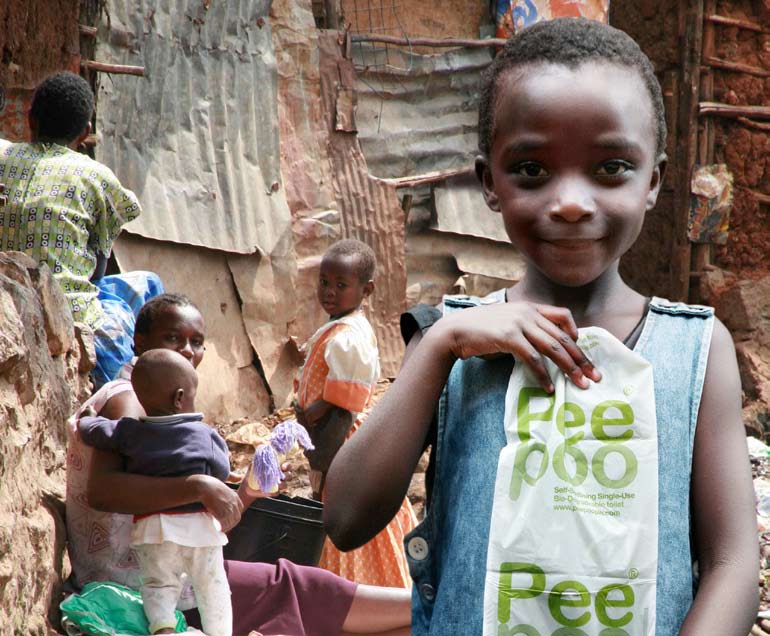
Peepoople is a Swedish company that addresses one of the United Nations Millennium Development Goals: to halve the proportion of people without sustainable access to drinking water and sanitation by 2015. Its contribution is the single use, biodegradable and self-sanitising Peepoo plastic bag which serves as a personal, portable and low-cost latrine.
The bag is lined with a coating that disinfects the waste, it is odour-free for at least 24 hours and within two to four weeks after use the bag content constitutes high quality fertilizer a usually expensive and scarce commodity in developing countries.
The fertilized Peepoo bags turn contaminants into a local resource which improves the soil’s structure and water-holding capacity and which, in the long term, will improve the potential harvest from the fields and enable simple economic systems to develop.
So, in one package Peepoople manages to provide not only an environmentally friendly solution to a public health problem, but an environmentally beneficial one as well. This is a great example of bottom-up innovation that starts with the “consumer” of the product and the specific situation they are in.
Affordable
Peepoo is employing simple and accessible technology to solve a problem that has been around as long as people have been pooping, and they are doing so affordably and with an easy-to-use product.
Peepoople currently sell Peepoos at price of about 0.1 Euro per unit. (Peepoos come in packs of 28 units for one person for one months at about 3 Euro exworks, when sold to UN, NGOs or developing countries). To end users in urban slums Peepoo is currently sold at a subsidized price with either the donor, NGO or governments financing the difference. It can also become financial selfsustainabile in urban slums in Kenya we project that will take another 5-7 years.
The ammonia-based sanitation technology applied in the Peepoo was scientifically proven initially back in 2008. I would say breakthrough of the Peepoo solution on the market was achieved during 2013, as we were able to start delivering large volumes to the market when our high-capacity production line became operational.
In urban slums we currently have about 20,000 regular users in Kibera slum in Nairobi, including 10,000 school children in 72 informal schools, and about 2,000 users in two schools in slums in Kisumu in Kenya. During 2014 Peepoo will also be introduced in slum in Goma in Congo. Our most recent deployments include Philippines, Syria and Pakistan.
It must make us wonder what other solutions to global challenges there are just waiting to be discovered. Perhaps you have one right in front of you?
Tania Ellis is a Danish-British prize-winning author, speaker and business advisor, specialized in social business trends and strategies. Her book The New Pioneers was listed on Cambridge’s Top 40 Sustainability Books.