

India aspires to become a developed, self-reliant economy. But can economic progress last if the ecological foundations supporting it continue to weaken?
The 2026 Environmental Performance Index (EPI), produced by the Yale Center for Environmental Law & Policy, ranks India 176th out of 177 countries. China ranks 129th, while Estonia ranks first. Estonia’s score has improved by more than 23 points over the past decade.¹
That is a wake-up call, and India should respond by examining what other countries are doing differently and adapting ideas that work.
Here is my checklist for closing some of India’s critical ecological gaps
1. The New Vision: Atma Nirbhar Bharat must sit alongside Bhumi Nirbhar Bharat
☐ Redefine self-reliance.
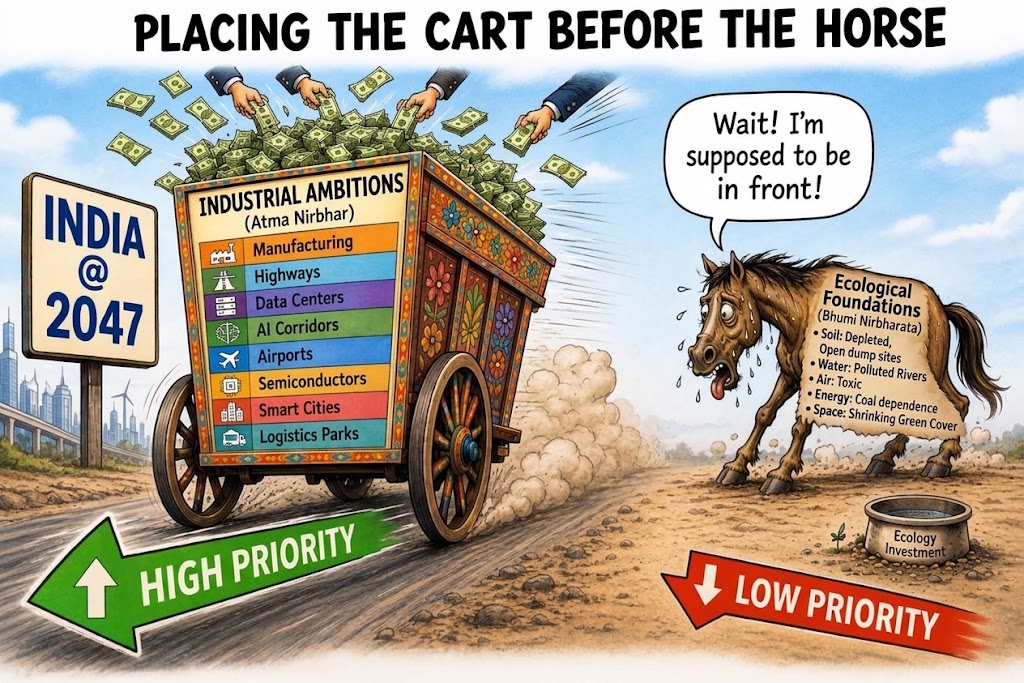
Atma Nirbhar Bharat represents India’s industrial and economic ambition. It must sit alongside Bhumi Nirbhar Bharat—the responsibility to protect the ecological foundations of prosperity.
Ancient Indian thought recognized five foundational elements, the Panchamahabhutas. For modern sustainability, I interpret them as soil, water, air, energy and space.
The principle is practical: care for the soil, protect water, clean the air, use energy wisely and use space responsibly.
Self-reliance should mean building an economy that prospers without exhausting the resources on which it depends.
2. Governance: Organize government by the five elements
☐ Create a five-element governance structure.
India already has a Ministry of Jal Shakti for water. Why not organize governance around all five elements?
Ministry of Soil: Soil health, land degradation, agricultural soil restoration and contaminated land.
Ministry of Water: Rivers, lakes, groundwater, sewage and water quality.
Ministry of Air: Air pollution, industrial emissions and ambient air quality.
Ministry of Energy: Energy security, renewable energy, efficiency and environmental impacts.
Ministry of Space: Efficient use of land and built space, urban planning and responsible outer-space activities.
These could be dedicated ministries or cabinet-level portfolios, supported by the necessary departments and technical institutions. Existing responsibilities would need to be reorganized to avoid duplication.
The same structure should apply to State governments.
The Finance Ministry already allocates budgets across ministries. Environmental outcomes should become an equally important consideration.
3. Policy: Measure what matters
☐ Create a citizen-facing Environmental ESG platform.
India should develop a unified environmental, social and governance (ESG) platform at the Centre and State levels. Its environmental component should report measurable indicators for soil, water, air and energy.
Citizens should be able to see how their state, city or district is performing and whether conditions are improving.
The Air Quality Index offers a useful starting point. Similar indicators are needed for soil health, water quality, waste management and renewable energy.
☐ Develop an Environmental Health Index.
Once reliable, comparable data are available, India could develop an Environmental Health Index (EHI) alongside GDP.
GDP measures economic progress, while EHI would measure the health of the ecological foundations supporting that progress. What we measure, we manage.
☐ Use GST to reward sustainable choices.
Products with demonstrably lower environmental footprints could receive preferential tax treatment, while products with higher environmental costs could face higher rates.
Millets and certified biodegradable materials, for example, could be considered for lower GST rates where evidence supports their environmental benefits. Generally, products that heal our planet also heal our health.
4. Soil: Reduce the pressure on land
☐ Restore soil health.
India should combine traditional agricultural wisdom with modern science to rebuild soil organic matter, improve soil structure and restore degraded land. Region-specific targets and measurable restoration plans are essential.
☐ Produce more without always demanding more land.
Biotechnology is opening new possibilities. GALY in the United States is developing cotton from plant cells. Finland’s VTT has demonstrated cell-cultivated coffee, while UPSIDE Foods has received US regulatory clearance for cultivated chicken.²
These technologies are at different stages of development. They will not replace conventional farming overnight, but India should participate early in industries that could eventually reduce pressure on agricultural land.
Done well, they would add ways to meet demand without displacing farmers, while potentially freeing land for forests, fruit-bearing trees and biodiversity.
☐ Turn old dumpsites into methane-control projects.
India’s open dumpsites occupy valuable land, pollute the environment and release methane.
Estonia offers a practical idea. At the Kudjape landfill, researchers recovered fine, soil-like material through landfill mining and used it as a methane-oxidizing biocover. The material supports naturally occurring bacteria that consume escaping methane and convert it primarily into carbon dioxide and water. Since methane has a much stronger warming effect than carbon dioxide over comparable periods, this process can substantially reduce the climate impact of landfill emissions.³
India could test this approach at selected dumpsites, including sites where biomining already produces large quantities of fine material.
After remediation, the land could be restored using nature-based solutions and suitable native trees, including sacred tree species.
☐ Keep food waste out of landfills.
South Korea banned direct landfilling of food waste in 2005 and built extensive collection and recycling systems. Its reported recycling rate is now around 98%.⁴ Indore has also demonstrated a good model for organic waste collection and conversion to biogas. More such examples are needed.
India should adopt the same principle: food waste should become biogas, compost, nutrients or other useful products.
Compact biodigesters could make decentralized treatment practical in markets, institutions, apartment complexes and food-processing facilities. Canada’s Vertogen Technologies promotes technology designed to shorten biogas production cycles substantially.⁵
5. Water: Make wastewater and sewage valuable resources
☐ Adopt China’s River Chief system.
China assigns named officials responsibility for particular rivers or river stretches. India could adapt this model by appointing a River Chief for every seriously polluted stretch.
The official should be accountable for monitoring water quality, coordinating pollution control and reporting progress publicly.
Citizens should know who is responsible, what the water quality is and whether it is improving. Without a named owner, responsibility that belongs to everyone tends to be exercised by no one.
☐ Transform sewage treatment plants into resource recovery plants.
Singapore has demonstrated the potential of wastewater reuse. The Netherlands has advanced resource recovery from sewage, including energy, nutrients and materials.
India should treat sewage plants as Resource Recovery Plants, producing reclaimed water, biogas, nutrients and useful materials.
Planners should ask how much value can be recovered from sewage as well as how to treat it.
☐ Explore DRDO’s microbial technology for decentralized sewage treatment.
DRDO’s anaerobic microbial consortium, developed to treat human waste and already operating in compact biodigester units on trains, merits further research as the biological core of compact sludge digesters for decentralized sewage treatment plants and urban biodigesters.⁶
Adapting this technology could make smaller treatment systems more practical for apartments, institutions and communities where conventional sewage infrastructure is inadequate. Pilot projects should establish its performance, operating costs and potential for recovering biogas and other useful resources.
6. Air: Turn pollution control into an economic opportunity
☐ Scale the Surat experiment.
Surat introduced India’s first particulate-emissions trading scheme in 2019. Industrial plants could trade permits within an overall emissions cap. An evaluation found that participating plants reduced particulate emissions by roughly 20–30% compared with conventional regulation.⁷
Other states should explore similar schemes where monitoring and enforcement are strong.
Well-designed markets can sometimes deliver cleaner air at lower compliance costs.
☐ Let biology help control industrial emissions.
HY-TEK Bio in the United States has developed micro algae systems to capture carbon dioxide from industrial flue gases while producing valuable biomass.
India should test suitable biological technologies at industrial sites and assess their actual emissions reductions, costs and commercial potential.
☐ Change the economics of urban transport.
Tax incentives should increasingly support electric ride-sharing, shared mobility and public transport. Higher taxes or fees on private-car ownership. Introduce green single passenger Autorickshaws for solo riders to alleviate congestion.
The goal is to recognize the environmental costs of congestion, parking, energy consumption and pollution while giving people practical alternatives.
7. Energy: Move from extraction to equilibrium
☐ Judge energy choices not only by cost and reliability, but also by their effects on soil, water, air and biodiversity.
☐ Explore decentralized energy, small wind, biodegradable metal-free batteries, compact bio digesters, novel cooling systems and so on.
☐ Scale technologies that demonstrate real environmental and economic benefits.
I have explored this subject in greater depth in my Sustainability Next article, “A Planet-Centric Energy Strategy for India.”
8. Space: Use the fifth element wisely
☐ Build in harmony with nature.
Space includes how we use land for homes, cities, roads and infrastructure. Vastu offers traditional perspectives on the relationship between the built environment and nature. These ideas should be examined alongside modern planning, climate science and engineering to identify practical benefits.
☐ Treat trees as living infrastructure.
Vriksha Ayurveda, the traditional science of trees and plants, offers a parallel perspective. Combining this knowledge with modern ecology can help cities select suitable trees for different locations and maintain them properly.
☐ Protect outer space before large-scale exploitation begins.
As commercial and scientific interest in lunar resources grows, humanity must establish responsible rules before large-scale extraction begins, or we may repeat on the Moon the mistakes we made on Earth.
I explored this question in my earlier Sustainability Next article, “Ten Powerful Reasons to Declare the Moon a Living Entity.”
9. Start now, while building for the long term
India need not wait for every reform to be completed before acting. It can begin by testing Estonia’s methane-oxidizing biocovers at selected dumpsites, keeping food waste out of landfills, appointing River Chiefs for polluted stretches and expanding the Surat model of market-based industrial pollution control.
Over time, these efforts should be supported by an Environmental Health Index, element-based governance, soil restoration and better recovery of resources from sewage.
But there is another opportunity India should pursue with urgency: building a bio-based economy.
Advances in microbial science, algae, plant cells and mycelium could lead to new materials, manufacturing processes and food products. These innovations could help replace conventional plastics and other fossil-based, energy-intensive materials. They could also open new markets for Indian entrepreneurs, create skilled jobs and reduce dependence on imported resources.
India should bring researchers, startups, farmers and established industries together to turn these possibilities into commercially viable products. Done well, this goes beyond swapping one material for another and finds better ways to make the things we need.
Atma Nirbhar Bharat can build India’s economic strength. Bhumi Nirbhar Bharat must protect the ecological foundations of that strength. A thriving bio-based economy can help bring the two ambitions together, which is the deeper meaning of Bhumi Nirbharata.
References and Notes
- Yale Center for Environmental Law & Policy. 2026 Environmental Performance Index. Yale University, 2026.
- GALY, company information on cell-cultivated cotton; VTT Technical Research Centre of Finland, research on cell-cultivated coffee, Journal of Agricultural and Food Chemistry, 2023; US Food and Drug Administration and US Department of Agriculture, regulatory information on cultivated chicken, 2022–2023.
- Kriipsalu, M. et al. Research on methane-oxidizing biocovers using fine material from landfill mining, Sustainability, 2020; subsequent full-scale investigation of landfill biocover performance, Process Safety and Environmental Protection, 2023.
- OECD, Environmental Performance Reviews: Korea, 2006; South Korean government reporting on food-waste recycling.
- Vertogen Technologies, company information on accelerated organic-waste-to-biogas processing.
- Defence Research and Development Organisation (DRDO), technology information on anaerobic microbial cultures and biodigesters for human-waste treatment. Further technical validation is needed for their proposed adaptation to decentralized sewage and sludge digestion.
- Greenstone, M., Pande, R., Ryan, N. and Sudarshan, A. Research on India’s particulate-emissions trading scheme, The Quarterly Journal of Economics, 2025; J-PAL evaluation materials.
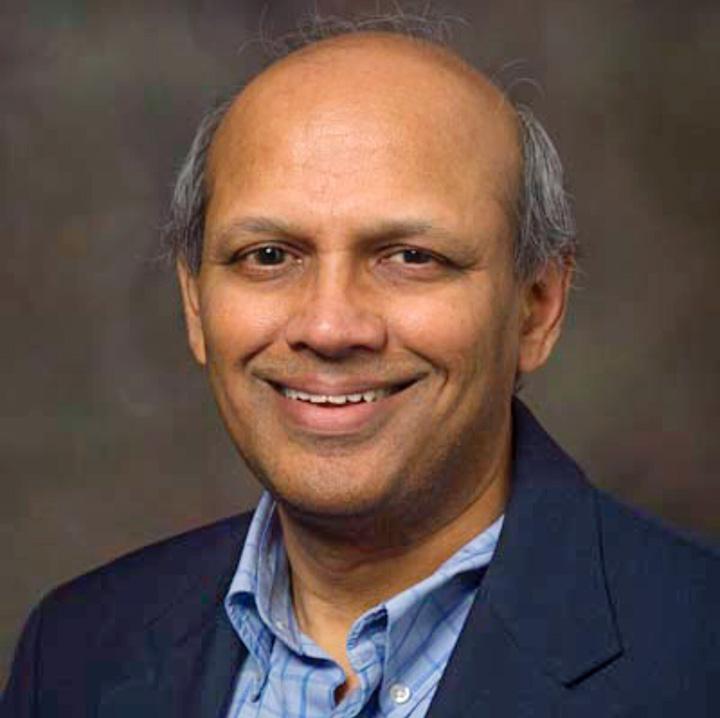
Ram Ramprasad is a regular contributor to Sustainability Next. He writes on sustainable strategies for India’s circular economy, climate resilience and ecological regeneration.