


A Personal Turning Point
In 2005, my doctor recommended surgery. The logic was straightforward, and I wasn’t opposed to it—but I remember sitting with a quiet unease, a feeling that the conversation had somehow skipped over me. The body was the problem. Fix the body. Move on.
That feeling led me toward Ayurveda. Not because I had become a believer in anything, but because I was looking for a different way to understand what was happening.
What I Observed in Kerala
What I found surprised me. The practitioners I met weren’t particularly interested in my diagnosis. They were more interested in patterns—how heat moved through the body, where things seemed stuck, what appeared excessive and what seemed depleted.
In this framing, disease wasn’t something you simply “had.” It was something that had developed over time, through accumulated imbalance. Which also meant it might, in some cases, be shifted.
Two things stayed with me after several visits. The first was how differently each patient was treated. Even when symptoms looked similar, prescriptions varied significantly—there was no single standard protocol. Treatment was built around the individual.
The second was the caution around herbs. Practitioners mostly preferred sourcing from the hospital’s own farm rather than relying on outside suppliers. Quality and origin clearly mattered.
These may sound like small details, but they pointed to something larger—a medical tradition that paid close attention to relationships: between the patient and their environment, between a plant and the soil it came from, between balance and its absence.
Five Elements, One Framework
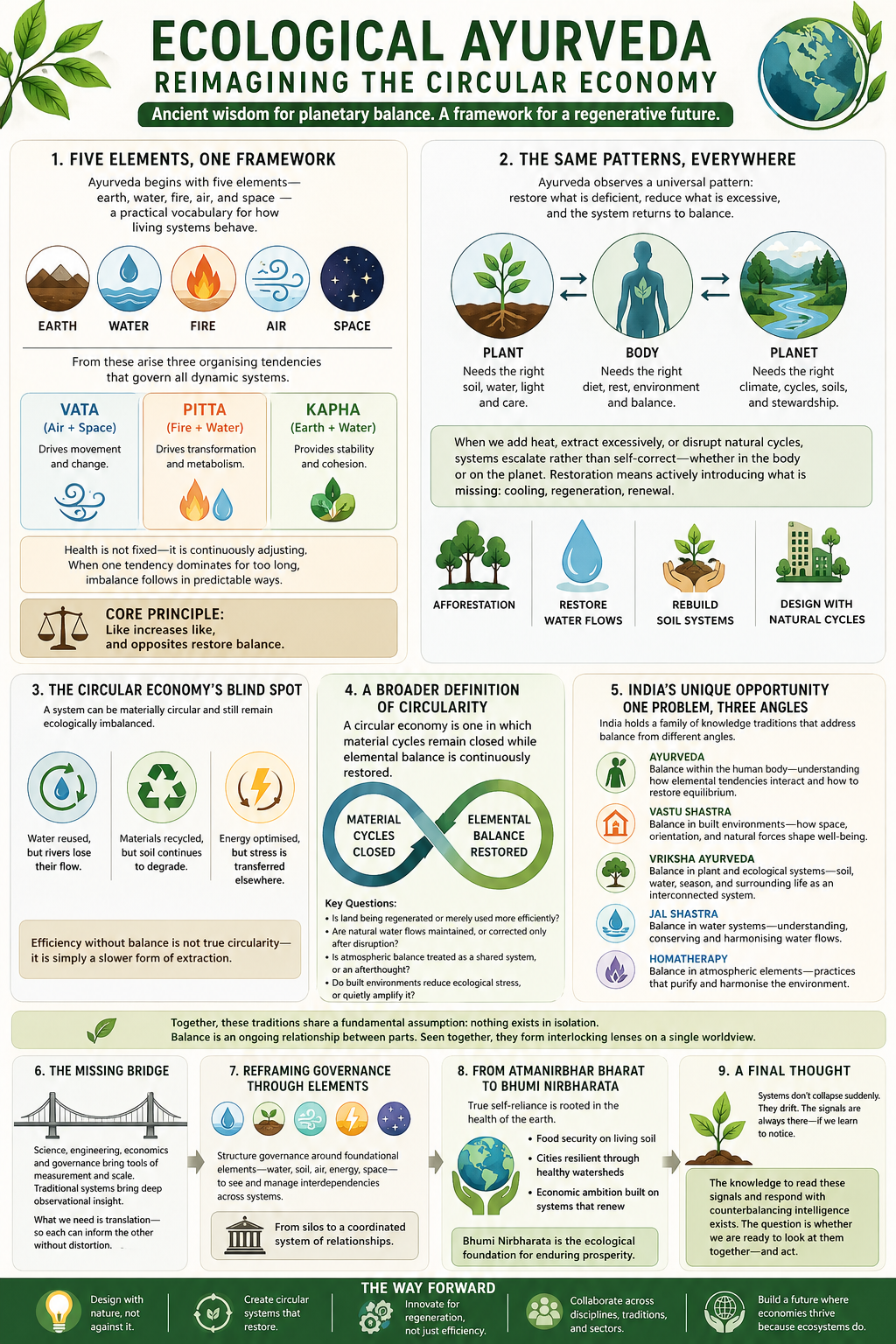
Ayurveda begins with five elements—earth, water, fire, air, and space—not as poetic metaphor, but as a practical vocabulary for how living systems behave. From these arise three organising tendencies: Vata (air and space), which drives movement and change; Pitta (fire and water), which drives transformation and metabolism; and Kapha (earth and water), which provides stability and cohesion.
The point is not to memorise these categories but to recognise what they imply: health is not fixed—it is continuously adjusting. When one tendency dominates for too long, imbalance follows in predictable ways.
At the core of this system sits a deceptively simple principle: like increases like, and opposites restore balance.
Add heat to a system already running hot, and it intensifies. Introduce something cooling, and the system gradually returns toward equilibrium. You see this clearly in the body—if someone already carries excess heat, adding more through diet or environment does not nourish; it aggravates. The response is not random. It follows a pattern.
The Same Patterns, Everywhere
Standing in a Kerala garden one morning, watching a practitioner tend medicinal plants with the same careful attention she brought to patients, it struck me: she was reading the same signals in both. Too much sun, too little water, the wrong soil—imbalance in a plant looks different from imbalance in a body, but the corrective logic is identical. Restore what is deficient. Reduce what is excessive. Watch how the system responds.
I found it hard, after that, not to see the same pattern at a much larger scale.
We are adding heat—through emissions, through the clearing of forests, through the spread of heat-absorbing surfaces—to a planet that is already warm. Temperatures rise. Cycles destabilise. The system escalates rather than self-corrects. Water appears where it shouldn’t and disappears where it should. Soil loses its vitality. Waste accumulates in forms that cannot reintegrate.
We tend to treat these as separate crises. But are they? Or are they different expressions of a single imbalance—the same way inflammation, acidity, and restlessness in the body are not three separate problems, but one system running too hot?
The Ayurvedic practitioner does not treat each symptom in isolation. She reads them as a single signal and responds with counterbalancing forces. The question this tradition poses to us, applied to the earth, is whether we are capable of the same reading.
Restoration, in both cases, is not only about reducing harm. It is about actively introducing what is missing: cooling where there is excess heat, regeneration where there is depletion, renewal where there is stagnation. In ecological terms—afforestation, restoring disrupted water flows, rebuilding soil systems, redesigning built environments to work with natural cycles rather than against them.
This is not simply a metaphor. It is a way of reading systems that may be as useful at planetary scale as it has been at the scale of the human body.
The Circular Economy’s Blind Spot
The circular economy represents important progress. Designing out waste, closing material loops, reusing resources—these are necessary shifts, and they are gaining real traction globally.
But there is a limitation worth naming. A system can be materially circular and still remain ecologically imbalanced. Water may be treated and reused while rivers lose their natural flow. Materials may be recycled efficiently while soil continues to degrade. Energy systems may be optimised while stress is quietly transferred elsewhere.
In such cases, circularity becomes mechanical rather than regenerative. Efficiency without balance is not true circularity—it is simply a slower form of extraction.
A Broader Definition of Circularity
From this perspective, circularity needs a second condition: A circular economy is one in which material cycles remain closed while elemental balance is continuously restored. Without that second condition, circular systems risk sustaining imbalance rather than resolving it. The questions become:
- Is land being regenerated or merely used more efficiently?
- Are natural water flows maintained, or corrected only after disruption?
- Is atmospheric balance treated as a shared system, or an afterthought?
- Do built environments reduce ecological stress, or quietly amplify it?
These are not separate domains. They interact continuously—and ignoring that interaction does not eliminate imbalance. It simply shifts it elsewhere.
India’s Specific Opportunity
What surprised me, returning to these questions, was that India already possesses the vocabulary—scattered across traditions that have never quite been read together.
One Problem, Three Angles
What makes India’s position distinctive is that it already possesses a set of knowledge traditions that address balance—not as a single unified theory, but as a family of disciplines that approach the same problem from different angles.
Ayurveda addresses balance within the human body—understanding how elemental tendencies interact, where imbalance originates, and how to restore equilibrium through diet, herbs, and practice.
Vastu Shastra approaches the same question through space—how the arrangement of elements within a built environment, its orientation, airflow, and relationship to natural forces, shapes the well-being of those who inhabit it.
Vriksha Ayurveda extends this to plant and ecological systems—treating soil, water, season, and surrounding life not as backdrop but as active participants in a living system that can be read and tended.
Complementary traditions like Jal Shastra apply similar logic to water systems, and atmospheric practices such as Homatherapy address elemental balance at a localised environmental scale.
What these traditions share is an assumption so basic it is easy to miss: nothing exists in isolation, and balance is not a static endpoint but an ongoing relationship between parts. Seen together, they form not a collection of separate disciplines but interlocking lenses on a single worldview—one in which the body, the home, the garden, the watershed, and the atmosphere are all expressions of the same underlying dynamic.
The opportunity for India is to recognise this not as heritage to be preserved, but as a living analytical framework—one that modern science, engineering, and governance could draw from, provided the translation is done carefully and without reduction.
The Missing Bridge
What remains largely absent is exactly that: a bridge. Scientists, engineers, economists, and policymakers operate with powerful tools for measurement and scale. Traditional systems offer deep observational insight into balance and interconnection. What is needed is translation—so that each can inform the other without distortion.
Reframing Governance Through Elements
When governance is structured around foundational elements—water, soil, air, energy, space—the interdependencies between systems become easier to see and manage. India has already taken a step in this direction with the Ministry of Jal Shakti. Extending this logic across other elemental domains could allow governance to function less in silos and more as a coordinated system of relationships.
From Atmanirbhar Bharat to Bhumi Nirbharata
India’s vision of Atmanirbhar Bharat emphasises self-reliance and economic resilience. But resilience built on depleted soil, disrupted water, and degraded air is resilience on borrowed time.
Bhumi Nirbharata—self-reliance rooted in the health of the earth itself—means that a village’s food security rests on living soil, that a city’s resilience draws from functioning watersheds, that economic ambition is built on systems that renew rather than deplete. It is not a replacement for economic ambition. It is the ecological foundation without which that ambition cannot endure.
A Final Thought
Most systems do not collapse suddenly. They drift. A river gradually loses volume. Soil fertility declines across seasons. Air quality deteriorates until thresholds are crossed and the damage becomes visible.
What Ayurveda offered me was not only a method of understanding health, but a way of noticing—of recognising the early signals of imbalance before they become breakdown. The body gives warnings long before it gives symptoms. A practitioner learns to read them.
So does the earth. And the signals are already there.
The knowledge to read them—and to respond with counterbalancing intelligence rather than isolated fixes—exists. It has existed for a long time, distributed across traditions that were always pointing at the same thing from different directions.
This reframing has practical consequences. If elemental balance becomes a design principle, it changes what we invent—materials that restore rather than merely reduce harm, built systems that work with natural cycles rather than despite them, innovations measured not only by efficiency but by whether they return something to the systems they draw from. And it raises a deeper question that this essay can only gesture toward: whether economics itself needs a different foundation—one built not on the management of extraction, but on the logic of renewal.
The question is whether we are ready to look at them together.
Ram Ramprasad is a sustainability writer and author. A graduate of Yale University in economics, he has published widely on platforms including Sustainability Next and TerraGreen, focusing on practical pathways for sustainable development.
Ram’s previous articles published in SustainabilityNext
Activating the World’s Dormant Climate Solutions
India’s LPG Crisis: A Three-Pillar Path to Resilient Cooking
How Mycelium Can Power a Green Startup Revolution
Microbes Can Drive India’s Sustainable Future
Rethinking India’s Sustainable AI Policy
Minimize Beef and Dairy Consumption
From Ātma Nirbhar to Ātma Bhūmi Nirbhar: India’s Civilizational Path to True Self-Reliance
Why India Needs a Millet Revolution
Common Sense Strategies to Reduce Methane Emissions from Cattle
Integrated Offshore Water and Wind Solution for India’s Coastal Cities
Gut and Soil Microbial SustainAbility Bridges Science and Ancient Indian Wisdom
From Waste to Wealth: Rebranding Sewage Treatment Plants (STPs) to Resource Recovery Plants (RRPs)
The Hidden Crisis with Our Beds
Startup ideas for Sustainable Cremation and Burial Solutions in India
How India’s Agriculture Can Save 200 Billion Cubic Meters of Water
Ten Powerful Reasons for Declaring Moon A Living Entity
Sustainable Wind Turbines: Balancing Bird Protection and Agriculture
A Holistic Water Strategy for India
How India Can Leverage its GST Model for Building a Sustainable Future
A Toolkit for India’s Green Transition
Green Building Strategy – Integrating Innovations from East and West
Eat Less Fish, Save the Planet
Startups are Working Hard for a Plastic-free World
Hydrogen More Harmful Than Fossil Fuels
Tech Startups Can Make India Water Rich
Measure How Basic Elements are Doing, Not Just GDP
A Radical Strategy for A Greener India – The Story of Kusha








[…] Ecological Ayurveda: Reimagining the Circular Economy […]
[…] Ecological Ayurveda: Reimagining the Circular Economy […]
[…] Ecological Ayurveda: Reimagining the Circular Economy […]