
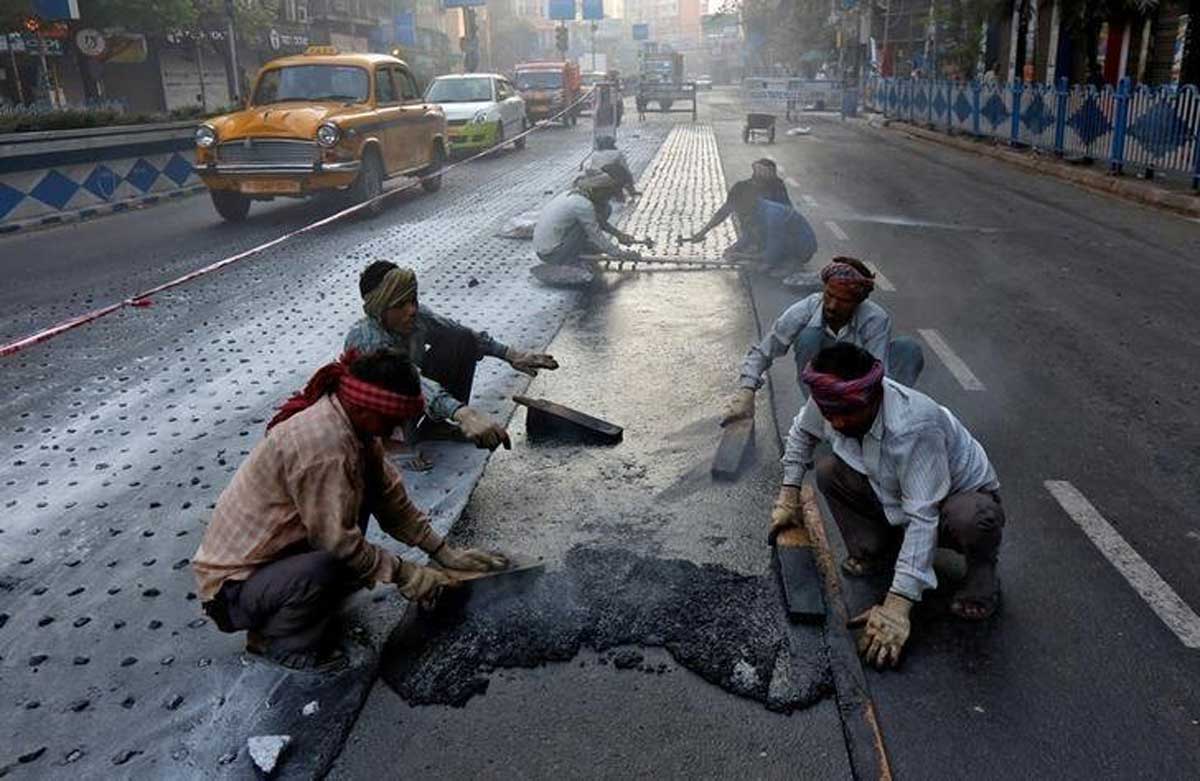
India’s recurring heatwaves are no longer distant warnings about climate change. They have become part of everyday life. In many cities, extreme summer temperatures are making outdoor work increasingly difficult.
While the causes of climate change are complex and global, one important contributor remains largely invisible to most citizens: methane emissions from India’s thousands of dumpsites, wastewater systems, and polluted rivers.
People easily recognize the visible consequences of poor resource practices—overflowing garbage, foul odors, polluted neighborhoods, and health risks. What remains unseen is the climate damage created when organic materials are buried in oxygen-starved dumpsites or left to decompose in polluted water bodies. Food scraps, vegetable peels, garden trimmings, sewage, and other biodegradable materials break down without oxygen and release methane, a greenhouse gas with more than 80 times the warming power of carbon dioxide over a 20-year period.
This invisible threat remains a major barrier to turning India’s waste problem into a resource opportunity.
The Swachh Bharat Mission has been one of India’s most successful public movements. It changed attitudes toward sanitation and cleanliness and encouraged millions of citizens to take responsibility for their surroundings. Its greatest strength was making an environmental problem visible to every household.
The next phase of India’s environmental progress must address a challenge that is far less visible: what happens after a banana peel leaves the kitchen, sewage leaves a household, or a bag of mixed materials leaves a home.
The challenge is no longer simply removing unwanted materials from sight. It is how intelligently we can recover the enormous value hidden within them.
Nature has always operated on a simple principle: nothing is wasted. A fallen leaf becomes food for microorganisms, nutrients return to the soil, and life continues through an endless cycle of regeneration. A circular economy is, in many ways, a return to this natural wisdom.
Organic materials can become compost that rebuilds India’s degraded soils or biogas that produces renewable energy. Wastewater can become recycled water, nutrients, and energy. Even methane escaping from old landfills can be captured and put to productive use.
India cannot build a true resource recovery economy unless citizens understand the climate consequences of how they handle organic materials. Technology, infrastructure, and government policies are essential, but lasting success depends on citizens understanding why their participation matters.
A household that separates kitchen materials because it understands its impact on climate change is far more likely to continue that practice than a household that separates materials simply because it is required to do so.
The Scale of India’s Methane Challenge
India generates nearly 60 million tonnes of municipal solid materials every year, and this number will continue to rise with urbanization and increasing consumption. More than half of this material stream is organic and can be converted into compost, renewable energy, and other valuable products.
The problem begins when biological resources are mixed with other discarded materials and transported to open or poorly managed dumpsites.
India has more than 3,000 dumpsites, many of them decades old, unlined, and poorly managed. A recent satellite study by the UCLA Stop Methane Project found that the Jawaharnagar dumpsite on the outskirts of Hyderabad emits 5.9 tonnes of methane per hour. Measuring methane emissions from India’s dumpsites, polluted rivers, and water bodies could help quantify their contribution to the country’s warming burden.
Communities living near these mountains of garbage can see the problem, smell the problem, and experience its health impacts, but they cannot see the greenhouse gases escaping into the atmosphere.
Climate education, transparent data, and modern monitoring technologies can help make this invisible problem visible and drive action.
A Six-Pillar Strategy for India’s Resource Recovery Future
No single technology or government initiative can solve India’s resource challenge. Success requires a combination of climate awareness, infrastructure, scientific innovation, social inclusion, ecological restoration, and strong governance.
Pillar One: Climate Literacy
For decades, India viewed discarded materials primarily as a sanitation issue. That perspective improved public cleanliness but did not fully connect everyday household behavior with methane emissions, climate change, and resource loss.
Schools, universities, resident welfare associations, local governments, and the media must help citizens understand that separating organic materials is not merely a cleanliness habit—it is climate action.
However, awareness alone is not enough. A household that carefully separates its organic materials will quickly lose confidence if municipal systems later combine everything in the same collection vehicle.
Public awareness and reliable resource recovery systems must grow together.
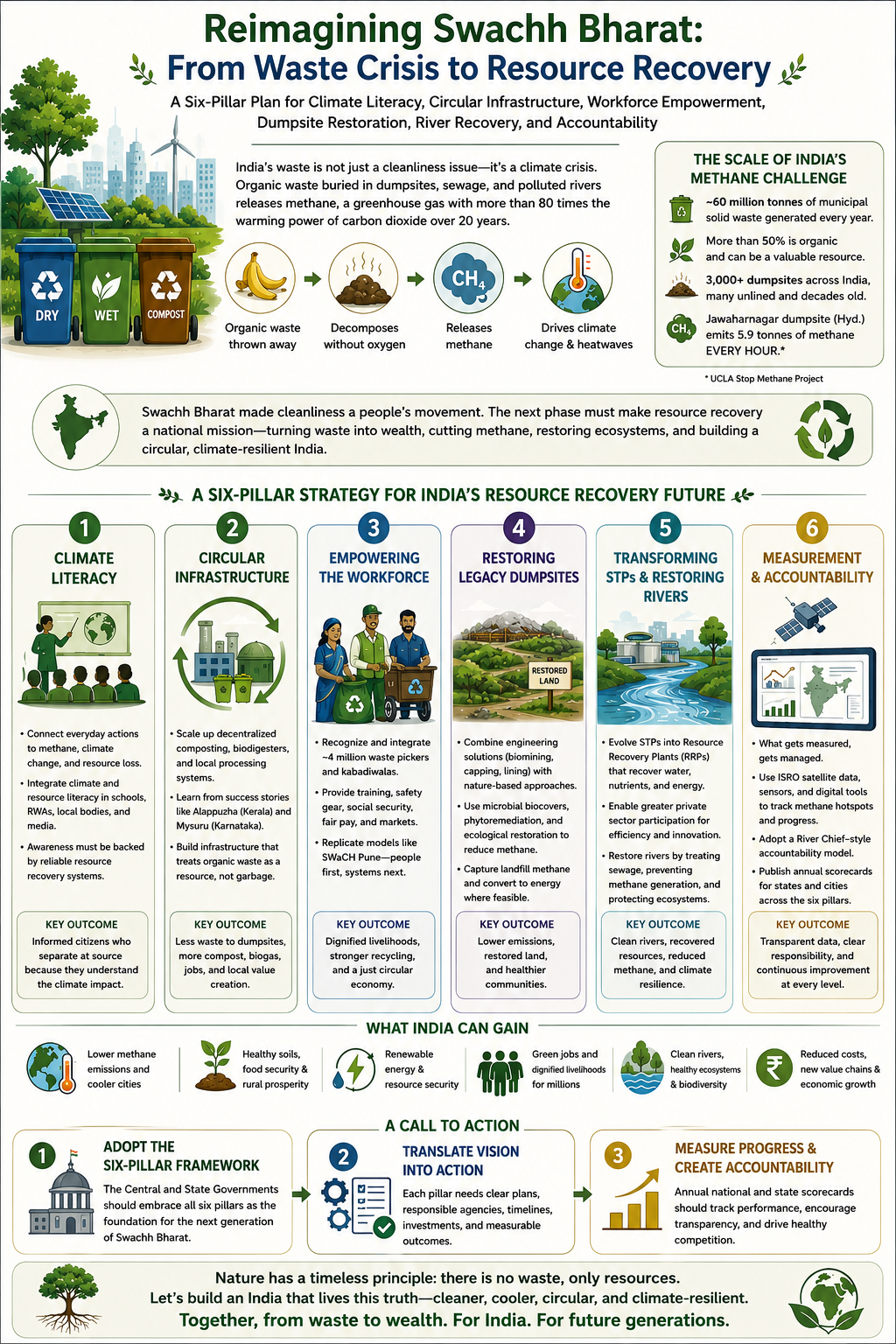
Pillar Two: Circular Infrastructure
India already has inspiring examples of decentralized resource recovery systems. Communities in Kerala and Karnataka have demonstrated that local composting, biodigesters, and neighborhood-level processing can greatly reduce dependence on large dumpsites.
Alappuzha in Kerala changed its approach through household and community composting. Mysuru, consistently recognized among India’s cleanest cities, built its success through sustained investment in segregation, collection, and decentralized processing.
These examples demonstrate an important lesson: organic matter is not garbage. It is a biological resource capable of restoring soils, producing clean energy, and creating economic value.
Pillar Three: Empowering the Resource Recovery Workforce
India’s transition to a resource recovery economy must begin by recognizing the millions of people who have been practicing circularity long before the term became popular. Nearly four million waste pickers and kabadiwalas collect paper, plastics, metals, glass, and other valuable materials every day, preventing enormous quantities of resources from reaching dumpsites.
Yet despite their contribution to environmental protection and the circular economy, most remain outside formal systems and often lack income security, healthcare, social protection, and safe working conditions.
The SWaCH cooperative in Pune offers a powerful example of a more inclusive model. Through its partnership with the Pune Municipal Corporation, thousands of waste pickers have been integrated into organized collection and segregation systems, improving both livelihoods and recycling outcomes.
India should build upon this existing human infrastructure rather than replace it. Training, protective equipment, access to better markets, fair compensation, and formal recognition can turn resource recovery workers into respected environmental service providers and circular economy entrepreneurs.
Pillar Four: Restoring Legacy Dumpsites
India’s thousands of legacy dumpsites represent one of the country’s most difficult environmental challenges. Even if all future materials were perfectly separated and processed, these decades of accumulated materials would continue releasing methane, contaminating soil and water, and damaging surrounding ecosystems.
Conventional engineering approaches such as excavation, transportation, biomining, and capping will continue to play an important role. However, they can be expensive, energy intensive, and disruptive. Nature can also become an ally in restoration.
Old dumpsites gradually develop microbial communities capable of consuming methane under appropriate conditions. Methane-oxidizing biocovers, engineered soils, phytoremediation, and ecological restoration can work with natural biological processes to reduce emissions and help restore damaged landscapes.
This offers a broader lesson: not every environmental problem requires more machines and concrete. When science works with nature’s own processes, restoration can often become more affordable and sustainable.
Beyond old dumpsites, India also has a tremendous opportunity to recover value from its vast quantities of agricultural residues, animal waste, and municipal organic materials.
Denmark provides an example of what is possible by integrating biomethane generated from organic resources into its national energy system. India has far greater quantities of biological resources. With supportive policies, decentralized biodigesters, and stronger markets for compost and biogas, these resources can improve energy security, strengthen rural livelihoods, restore soils, and reduce methane emissions.
Pillar Five: Transforming STPs and Restoring Rivers
India’s rivers reflect both its ancient heritage and its modern environmental challenges. Rivers such as the Ganga and Yamuna are not only suffering from visible pollution; the accumulation of untreated sewage and organic materials can also create oxygen-poor conditions that produce methane and other greenhouse gases.
This makes river restoration not only a water quality challenge but also an important climate priority.
For decades, sewage treatment plants (STPs) have largely been designed with a narrow objective—to treat wastewater before discharge. The next generation of these facilities should evolve into Resource Recovery Plants (RRPs) that recover clean water, nutrients, and renewable energy.
State and Central governments should consider greater private sector participation in operating these facilities to improve efficiency, maximize resource recovery, encourage innovation, and ensure that valuable resources are not lost.
Wastewater should no longer be viewed as a liability to be treated and discharged. It should be recognized as a continuous stream of water, nutrients, and energy waiting to be recovered.
Pillar Six: Measurement and Accountability
The old management principle remains true: what gets measured gets managed. Ambitious environmental goals require clear responsibility, transparent reporting, and continuous evaluation.
India can draw lessons from China’s River Chief system, which assigned individual officials responsibility for specific stretches of rivers and evaluated their performance based on measurable environmental outcomes.
India already applies a similar philosophy in forest management, where officials are responsible for defined landscapes. A comparable approach could be expanded to major rivers, legacy dumpsites, and other critical environmental assets, assigning clear responsibility not merely for cleanliness but for reducing methane emissions, restoring ecosystems, and maximizing resource recovery.
India possesses a powerful advantage through ISRO’s advanced satellite and Earth observation capabilities. These technologies can identify methane hotspots, track progress at individual dumpsites, and provide an objective basis for environmental accountability.
Annual public scorecards comparing states and cities across the six pillars can encourage healthy competition, guide investments, and accelerate innovation.
The expansion of Swachh Bharat into a broader resource recovery movement will ultimately depend not only on technology or funding, but on the ability to measure progress and reward success.
A Call to Action
The first phase of Swachh Bharat showed that India can achieve large-scale change when government, institutions, and citizens work toward a common goal. The next phase should build on that success by turning India’s waste challenge into a resource recovery opportunity.
Three actions are essential:
Adopt the Six-Pillar Framework
The Central and State Governments should embrace climate literacy, circular infrastructure, workforce empowerment, dumpsite restoration, wastewater and river recovery, and accountability as the foundation for the next generation of Swachh Bharat.
Translate Vision into Action
Each pillar must have clear implementation plans, responsible agencies, timelines, investments, and measurable outcomes.
Measure Progress and Create Accountability
Annual national and state scorecards should track performance across the six pillars, encouraging transparency, accountability, and healthy competition.
India already has the people, resources, and scientific capabilities needed to succeed.
A nation that mobilized millions to keep its surroundings clean can now lead a deeper environmental shift based on nature’s timeless principle: there is no waste, only resources waiting to return to the cycle of life.
Ram Ramprasad is a regular contributor to Sustainability Next, writing on sustainable strategies for India’s circular economy, climate resilience, and ecological regeneration.
Ram’s previous articles published in SustainabilityNext
How Cell-Cultivated Cotton Could Transform India’s Textile Sector
India’s Landfill Methane Crisis: The Power of Nature-Based Solutions
Rivers Revive When Someone Owns the Outcome
Ecological Ayurveda: Reimagining the Circular Economy
Activating the World’s Dormant Climate Solutions
India’s LPG Crisis: A Three-Pillar Path to Resilient Cooking
How Mycelium Can Power a Green Startup Revolution
Microbes Can Drive India’s Sustainable Future
Rethinking India’s Sustainable AI Policy
Minimize Beef and Dairy Consumption
From Ātma Nirbhar to Ātma Bhūmi Nirbhar: India’s Civilizational Path to True Self-Reliance
Why India Needs a Millet Revolution
Common Sense Strategies to Reduce Methane Emissions from Cattle
Integrated Offshore Water and Wind Solution for India’s Coastal Cities
Gut and Soil Microbial SustainAbility Bridges Science and Ancient Indian Wisdom
From Waste to Wealth: Rebranding Sewage Treatment Plants (STPs) to Resource Recovery Plants (RRPs)
The Hidden Crisis with Our Beds
Startup ideas for Sustainable Cremation and Burial Solutions in India
How India’s Agriculture Can Save 200 Billion Cubic Meters of Water
Ten Powerful Reasons for Declaring Moon A Living Entity
Sustainable Wind Turbines: Balancing Bird Protection and Agriculture
A Holistic Water Strategy for India
How India Can Leverage its GST Model for Building a Sustainable Future
A Toolkit for India’s Green Transition
Green Building Strategy – Integrating Innovations from East and West
Eat Less Fish, Save the Planet
Startups are Working Hard for a Plastic-free World
Hydrogen More Harmful Than Fossil Fuels
Tech Startups Can Make India Water Rich
Measure How Basic Elements are Doing, Not Just GDP
A Radical Strategy for A Greener India – The Story of Kusha