


A few decades ago, I visited my brother in Germany and still remember the stench while crossing the Rhine. At the time, Europeans openly called it the sewer of Europe.
Decades later, during China’s rapid industrial expansion in the 1990s and early 2000s, stories circulated about stretches of the Pearl River turning different colours from textile dyes. People joked that one could predict fashion trends in Europe by looking at the river.
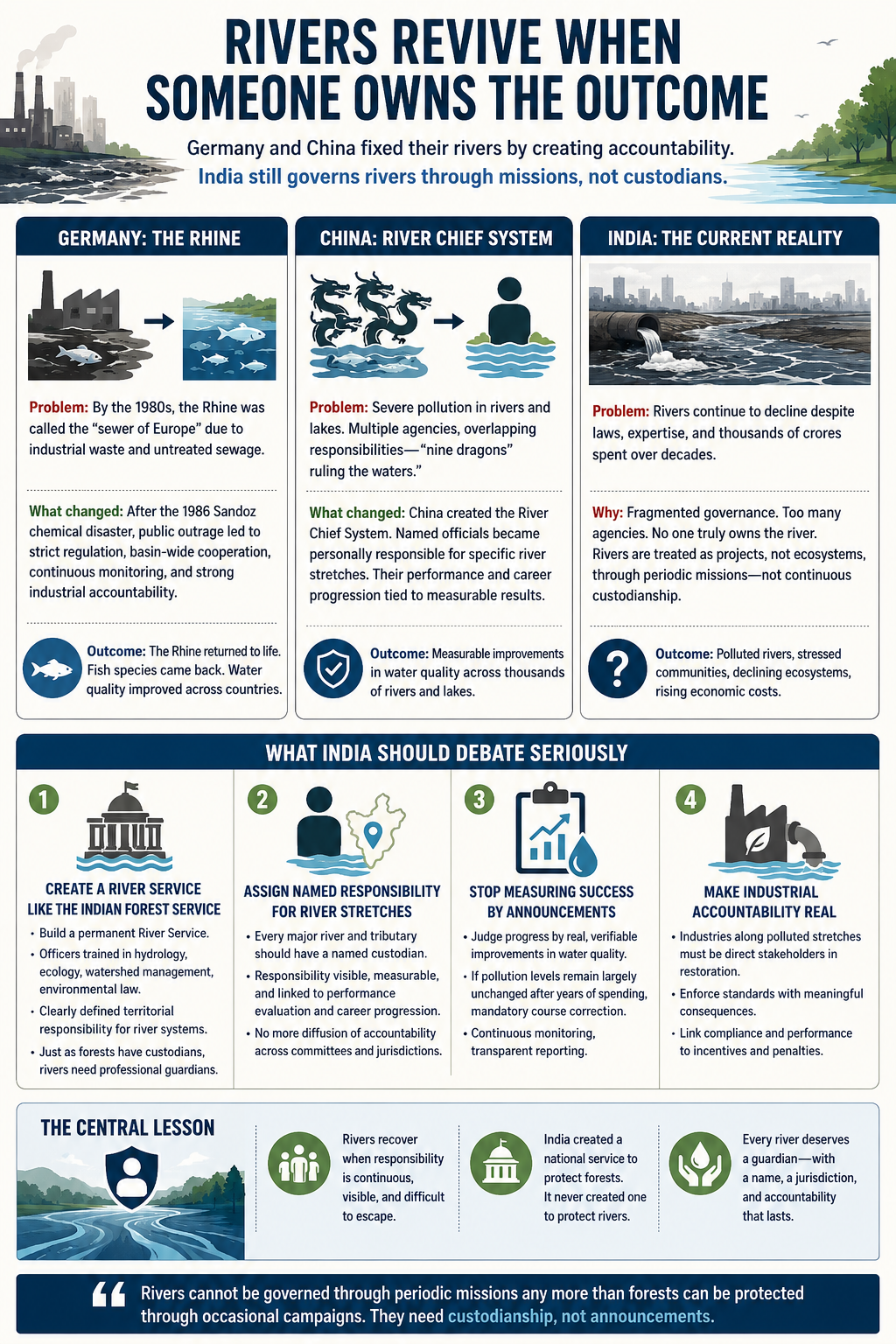
Neither Germany nor China was once seen as a model for river restoration. Both allowed major rivers to deteriorate badly during periods of rapid industrial growth. But both eventually changed course.
India, despite decades of river missions, public campaigns, and thousands of crores in spending, largely has not. The Yamuna flowing through Delhi still carries untreated sewage, industrial discharge, chemical foam, and the accumulated failure of fragmented governance. Similar stories repeat across the country — from the Mula-Mutha in Pune to the Cooum in Chennai and the Damodar in eastern India.
Anyone standing near the Yamuna in Delhi knows this is no longer a problem hidden inside government reports. The problem is not a complete absence of laws, expertise, or spending. What India lacks is custodianship.
What Germany and China Eventually Understood
Germany’s turning point came after years of worsening pollution culminated in the 1986 Sandoz chemical disaster near Basel, when toxic chemicals entered the Rhine and contaminated water across multiple countries. Public anger changed the political calculus quickly.
The response was not another periodic clean-up campaign. Germany and its European partners tightened regulation, coordinated basin-wide monitoring, imposed stricter industrial accountability, and sustained pressure over years rather than election cycles. Industries invested heavily in treatment systems because the reputational, financial, and regulatory consequences of failure became real.
The Rhine recovered. Fish species returned. Sections once considered biologically dead came back to life.
China reached a similar conclusion differently. By the 2000s, years of industrial expansion had severely polluted major rivers and lakes. Multiple agencies shared overlapping responsibility while nobody fully owned outcomes — what Chinese officials themselves called “nine dragons ruling the waters.”
China responded with the River Chief System. Named officials became directly responsible for specific stretches of rivers and lakes. Their performance evaluations and career advancement became linked to measurable environmental outcomes.
Different political systems. Different methods. But both countries eventually forced someone to own the outcome.
India Governs Rivers Episodically
India largely treats rivers as projects to be funded rather than ecosystems requiring continuous custodianship. The country launches missions. Allocates budgets. Builds sewage treatment plants. Announces deadlines. Then another program follows.
But rivers cannot be governed through periodic campaigns any more than forests can be protected through occasional missions.
Oddly, India solved a similar governance problem decades ago. Forests required trained custodians, territorial responsibility, continuity, hierarchy, and career accountability. India created the Indian Forest Service (IFS), one of the country’s premier All India Services.
A Range Forest Officer is responsible for a defined geography. A Divisional Forest Officer oversees a larger forest division. The structure may not be perfect, but the principle is clear: there is a named officer responsible for a living ecosystem. India never built an equivalent institutional structure for rivers.
Water stress, polluted rivers, collapsing groundwater tables, and declining watershed health are no longer isolated environmental concerns. This is no longer just an environmental issue. Farmers feel it. Cities feel it. Industry will increasingly feel it too.
India’s environmental governance architecture was largely designed in an era when forests were seen as the primary ecological asset requiring territorial protection. The 21st century may demand an equally serious institutional architecture for rivers, watersheds, and water systems.
What India Should Debate Seriously
India does not need another river-cleaning slogan. It needs a governance reset centred on accountability and custodianship. Some ideas deserve serious national debate.
- Create a River Governance Structure Similar to the Indian Forest Service
- India should explore building a permanent river custodianship framework that could eventually evolve into a specialised River Service.
- Officers trained in hydrology, river ecology, watershed management, environmental law, and inter-state coordination should have clearly defined territorial responsibility for river systems.
- Just as forests have custodians, rivers need professional guardians.
- Assign Named Responsibility for River Stretches
- Every major river and tributary should have clearly identified officials responsible for ecological outcomes within defined stretches.
- Responsibility should be visible, measurable, and linked to performance evaluation and career progression.
- When rivers deteriorate continuously despite years of expenditure, accountability should not disappear into committees and overlapping jurisdictions.
- Stop Measuring Success by Announcements
- India has launched multiple river missions over decades. The real test is whether rivers are measurably cleaner over time.
- If pollution levels remain largely unchanged after years of spending, course correction should become mandatory rather than politically avoidable.
- Make Industrial Accountability Real
Industries operating along heavily polluted stretches must become direct stakeholders in restoration outcomes through enforceable standards and meaningful consequences for non-compliance.
Germany demonstrated that industry responds when accountability becomes unavoidable.
These are not final answers. They are starting points for a more serious national debate on river governance than India has had so far.
Rivers Need Guardians, Not Periodic Missions
India’s river crisis is often discussed as a technical or financial problem. But beneath all of that lies a simpler governance failure. Nobody truly owns the river.
Germany improved the Rhine when industry could no longer evade responsibility. China improved many of its rivers when officials became directly accountable for outcomes.
India does not need to copy either model mechanically. But it does need to absorb the central lesson both eventually learned: ecosystems recover when responsibility becomes continuous, visible, and difficult to escape.
Every river in this country deserves more than recurring missions, periodic budgets, and ceremonial promises. It deserves a guardian with a name, a jurisdiction, and responsibility that cannot dissolve into the system.
Ram Ramprasad writes on development, governance, and ecological systems. He is an economics graduate of Yale University.
Ram’s previous articles published in SustainabilityNext
Ecological Ayurveda: Reimagining the Circular Economy
Activating the World’s Dormant Climate Solutions
India’s LPG Crisis: A Three-Pillar Path to Resilient Cooking
How Mycelium Can Power a Green Startup Revolution
Microbes Can Drive India’s Sustainable Future
Rethinking India’s Sustainable AI Policy
Minimize Beef and Dairy Consumption
From Ātma Nirbhar to Ātma Bhūmi Nirbhar: India’s Civilizational Path to True Self-Reliance
Why India Needs a Millet Revolution
Common Sense Strategies to Reduce Methane Emissions from Cattle
Integrated Offshore Water and Wind Solution for India’s Coastal Cities
Gut and Soil Microbial SustainAbility Bridges Science and Ancient Indian Wisdom
From Waste to Wealth: Rebranding Sewage Treatment Plants (STPs) to Resource Recovery Plants (RRPs)
The Hidden Crisis with Our Beds
Startup ideas for Sustainable Cremation and Burial Solutions in India
How India’s Agriculture Can Save 200 Billion Cubic Meters of Water
Ten Powerful Reasons for Declaring Moon A Living Entity
Sustainable Wind Turbines: Balancing Bird Protection and Agriculture
A Holistic Water Strategy for India
How India Can Leverage its GST Model for Building a Sustainable Future
A Toolkit for India’s Green Transition
Green Building Strategy – Integrating Innovations from East and West
Eat Less Fish, Save the Planet
Startups are Working Hard for a Plastic-free World
Hydrogen More Harmful Than Fossil Fuels
Tech Startups Can Make India Water Rich
Measure How Basic Elements are Doing, Not Just GDP
A Radical Strategy for A Greener India – The Story of Kusha








[…] Rivers Revive When Someone Owns the Outcome […]
[…] Rivers Revive When Someone Owns the Outcome […]