
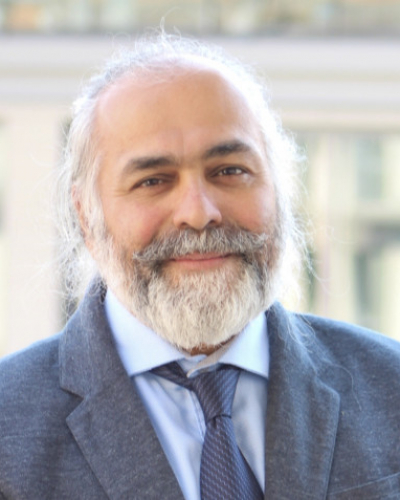
Welcome, Prof. Dev Niyogi, to the SustainabilityNext Dialogue series. This series brings together business, social, and scientific leaders to demystify complex problems and solutions for our audience of entrepreneurs, professionals, and graduate students. It’s a privilege to have you. Excerpts of a chat with Benedict Paramanand, Editor, SustainabilityNext. Prof. Niyogi is the Chair Professor in Jackson School of Geosciences, UNESCO Chair AI, Water & Cities, University of Texas at Austin, also Professor Emeritus, Purdue University. https://niyogi.dev
You are deeply involved in AI and a founding member of the Indian AI Research Organization. Given India’s climate problems, how can AI help solve them and in which areas?
This is a really important question: where do we see AI coming into the picture for helping with immediate challenges, whether in sustainability, climate extremes like heat, cloudbursts, heavy rains, or even day-to-day issues like traffic due to rainfall. There are also long-term planning challenges like deciding energy pathways: renewable vs coal-based futures.
These problems are not linear. Climate is what we call a “wicked problem.” A wicked problem does not have an endpoint. Global hunger is a wicked problem. Terrorism is a wicked problem. It’s the same with climate. These problems require solving in pieces. Sometimes solving one problem creates another. There are feedback loops. So you need to consider multiple pathways and optimize solutions. So far, we’ve relied on human experience, policy, and technological advances and we’ve come far, from the Green Revolution to satellite technology to entrepreneurial growth.
Do you think AI has renewed our confidence that climate problems can be solved?
Climate solutions fall into two categories: mitigation and adaptation. Mitigation focuses on reducing greenhouse gases, while adaptation involves adjusting to impacts, like carrying an umbrella when it rains. We already understand many solutions; the challenge is scaling them effectively.
AI helps scale these solutions so that industry, academia, and governments can work together to create impact at city and regional levels. This opportunity has not existed before. AI acts as a great integrator, bringing together different disciplines onto a common platform. If leveraged properly, it can lead to remarkable progress.
Where does this fit into the Indian AI Research Organization (IAIRO)’s mission.
IAIRO creates infrastructure and a platform for people with ideas, intent, and technology to connect. Like the internet enabled innovation without instructions, IAIRO enables collaboration across industry, government, and society. It allows the creation of solutions that are much bigger than individual contributions. However, it needs strong backing from the private sector, particularly long-term investment rather than short-term returns.
What stage is IAIRO currently at?
IAIRO is an active entity based in GIFT City. It involves partnerships with the Government of Gujarat, academia such as the University of Texas and UC Irvine, and support from MeitY. There are also collaborations with ministries and agencies. Currently, it is at an exciting stage where many things are coming together. The next step is scaling through greater private sector involvement.
Is there hesitation from the private sector?
I don’t think hesitation is the right word. The private sector is excited about AI. The challenge is the lack of structured mechanisms for long-term investment in research. Unlike the US, where institutions were built through visionary funding, India is still developing such frameworks. Once established, it can create significant momentum. Historically, figures like Carnegie and Ford funded long-term innovation. India needs similar vision-driven investment.
With multiple AI ecosystems emerging across India, are they competing with each other?
No, competition is not the right word. We need many more such ecosystems. India has a global footprint, and these initiatives should contribute collectively to global impact.
What are the key climate problems India should address using AI?
Climate is local. Each region faces different challenges: Bangalore with traffic and power, Gujarat with heat, Uttarakhand with cloudbursts, and eastern regions with cyclones. The focus should be on local solutions that can later scale up. We don’t need to solve everything globally at once; we need to improve local tools and systems.
What is one major challenge you are currently working on?
One major area is digital twins, which involve using AI and technology to create virtual models of systems like cities. These models allow the simulation of scenarios and future planning. I see digital twins today as similar to what e-commerce was 20–25 years ago. They will become fundamental to how cities operate. The challenge is building scalable frameworks and prototypes.
Can AI accelerate Paul Hawken’s carbon drawdown efforts?
Drawdown is part of mitigation. Even if we achieve carbon targets, the impact will take time due to the long lifespan of carbon. Therefore, adaptation is equally important. AI can play a significant role in delivering immediate adaptation solutions while mitigation continues.